
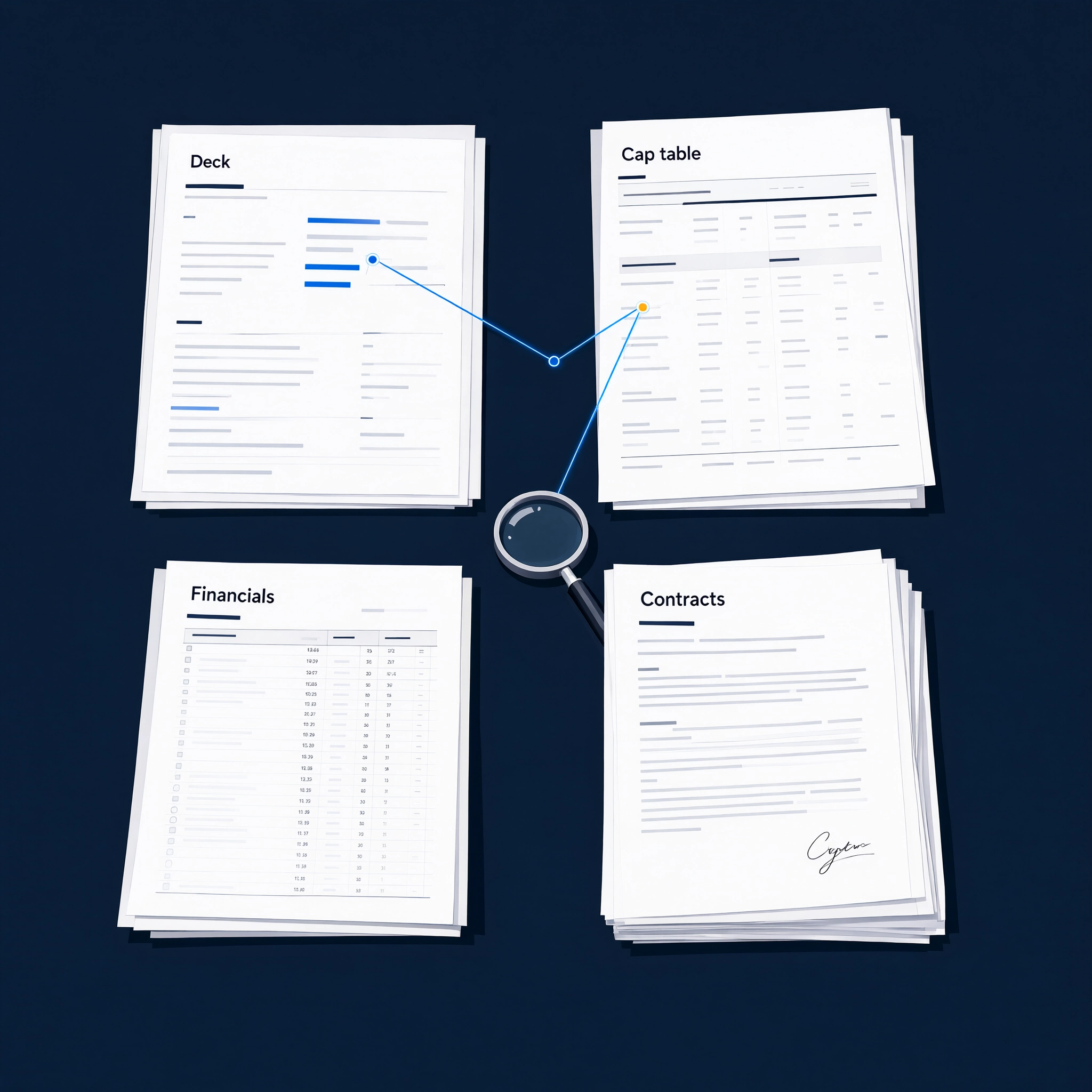
A startup due diligence checklist should answer two questions: what will investors verify, and where do your documents disagree? Startup due diligence is the investor's verification of what you have claimed, covering financial statements, incorporation and contracts, the cap table and option ledger, operations, and market and product evidence. The recurring problem is not missing brilliance. It is disagreement between documents: a figure in the deck that appears in no accounting record, a cap table that lags the last board meeting, a contract held only in someone's inbox.
The Startup Due Diligence Process and Why Investors Run It
Carta states that signing a term sheet starts due diligence rather than closing a funding round. That is one provider's framing of the fundraising sequence it sees in its own work, not a universal rule: some investors run lighter checks earlier, and scope varies by investor. The practical point holds either way. The documents you need must already exist when the request list arrives, because the clock is running from that point.
The purpose of due diligence in a startup investment is verification. Investors test what you have claimed against records, contracts and third-party context. Fidelity Private Shares frames the same exercise from the founder's side: investors want a consistent story, one where the pitch deck, financial statements, cap table, and legal documentation all align. Neotas organizes its 2026 investment due diligence checklist into seven workstreams (financial, legal and regulatory, commercial, operational, people and integrity, technology and IP, and ESG), which is one provider's framework rather than a definition of what every investor will request.
Scope varies by stage, investor and round size. The three sources named here describe their own practices and frameworks, not a universal industry standard, and no checklist replaces the specific request list an investor gives you.
What Do Investors Examine in Each Area?
The five areas below organize this article's analysis of the categories founders should expect. The failure modes are the ones the sources and the checklist logic support, and they follow a recognizable pattern.
Financials: investors look for clean historical statements, realistic projections, cash runway visibility, and revenue quality. The friction point is arithmetic that does not tie out. An ARR figure in the deck is the classic case. Before treating any difference as an error, check that the deck and the accounting system are using the same definition, the same period and the same currency. A difference that survives that comparison raises a question about reporting accuracy, and the question has to be answered before the review moves on. Forecasts sit in a different category: they are not expected to match any record, but they should be labeled as forecasts and carry stated assumptions rather than sitting beside historical figures as if they were results.
Legal: incorporation documents, board consents, customer and vendor contracts, IP assignments, and employment agreements, in current versions rather than superseded drafts. Missing or outdated versions invite the question of how the rest of the records will look, which is why they are worth catching early.
Equity and ownership: a cap table that matches grant agreements, option ledgers, vesting schedules, and board approvals, plus a current 409A valuation where that instrument applies. This is where scattered records surface fastest.
Operations: hiring practices, org design, documentation habits, dependencies, and vendor relationships, which together show whether systems will scale as the company grows.
Market and product: competitive differentiation, product roadmap, customer insights, market size, and traction indicators. Evidence here is what separates a claim from a demonstrated result.
What Documents Do Investors Ask For Before the First Meeting?
There is no single universal request list. What you can control is whether the standard categories already exist in organized form before anyone asks. The practical preparation is to keep a running folder of commonly requested materials and to review it yourself, or with an advisor, as if you were the outside party: the exercise of looking for your own gaps is the same skill as answering someone else's request list.
A practical pre-meeting inventory looks like this: certificate of incorporation and all amendments; board and stockholder consents for prior financings and option grants; the current cap table with the option ledger and vesting schedule; the most recent 409A valuation where that applies; monthly financial statements plus a cash runway view; the deck, with each historical figure traceable to those statements and each forecast labeled as a projection with its assumptions; founder, employee and contractor IP assignments; key customer, vendor and employment agreements; licenses, permits and any regulatory obligations in your markets; a short list of market and customer evidence behind your traction claims, including the source and method behind any market-size figure; and the people, technology and security records covered in the checklist below.
Consistency does not mean every number in every document is identical. Three different rules apply. Historical figures, meaning anything that has already happened, must reconcile to a record once definition, period and currency are aligned. Forecasts must be labeled as forecasts and carry stated assumptions, so a reader can see which inputs would have to hold. External figures, such as a market-size estimate, need a traceable source and a stated method rather than agreement with your accounts. The failure the sources describe is a figure presented as fact that no record supports, or two documents giving different answers to the same question.
Notice what is absent from that list: audited statements. Early-stage companies rarely have them, and this inventory is built on that assumption. It is assembled from management accounts and source documents, which is also why consistency between those documents carries so much weight.
How Long Does Startup Due Diligence Take?
Carta states that for a Series A, startup due diligence at this stage typically runs four to six weeks, though it moves faster when your records are clean and organized. That is one provider's stated practice for one round stage, not a benchmark for every deal. Duration depends on stage, round size, investor process, and how much specialist review is involved, so the useful question to put to your lead investor is what schedule they expect for this round.
The reason record quality moves the timeline is simple. Clean records compress the middle stage because the investor spends time verifying rather than hunting. Disorganized records extend it, and every week of extension is a week in which your runway and the market both keep moving.
Startup Legal Due Diligence: Incorporation, Contracts and IP
Startup legal due diligence is where the company proves it exists on paper and owns what it says it owns. The core set is incorporation documents, board consents, customer and vendor contracts, IP assignments, and employment agreements, with current versions rather than superseded drafts. What counts as complete depends on your jurisdiction, on how the company was formed, and on what your contracts actually require, so your counsel, rather than this list, confirms which items apply.
IP assignment deserves separate attention because the chain is easy to break and hard to notice from inside the company. The working practice is a written assignment from each founder, employee and contractor who contributed to the product, kept with the rest of your corporate records. Whether a particular signature is legally required, and what follows from its absence, depends on the contract terms and the jurisdiction, so counsel is the person who can tell you where a gap is a defect and where it is a formality. What you can act on without waiting for that opinion is whether the assignment exists at all: a contribution with no assignment on file is a question your counsel has to answer mid-review, and that answer takes time out of the schedule.
Board consents are the other quiet failure. If a financing, an option grant, or a founder share issuance happened without a matching written approval, the corporate record and the ownership records may not tell the same story, and that disagreement is what an investor's counsel is hired to find. Whether a missing approval is a legal defect or a formality depends on the jurisdiction, the instrument and the terms involved, so counsel is again the person who can tell you. The action is the same and it is cheap: check now that a written approval exists for every issuance and grant, and raise any absence with counsel before the request list arrives rather than in the middle of the review.
What Makes a Cap Table or 409A Valuation Stale?
A cap table is stale when it no longer matches the events that changed ownership. Fidelity Private Shares identifies the specific trigger: if the cap table has not been updated after option exercises, cancellations, or new hires, investors will likely flag it quickly. The shape a discrepancy takes is easy to picture: a grant agreement in one inbox, an offer letter in an HR folder, an exercise notice over chat. That is an illustration of how discrepancies get created in the first place, and it is why centralizing equity records matters.
A 409A valuation goes stale when it no longer reflects the company's current state, and Fidelity Private Shares lists cap table and 409A valuation drift together among the friction points founders hit. The first question is whether a 409A applies to your company at all, which depends on your jurisdiction and structure. Founders to whose companies it does not apply should confirm with their own advisors which valuation record is expected instead. Where a 409A does apply, its purpose, the refresh cadence and the events that force a new valuation are questions for your tax advisor rather than rules to read off a checklist: ask what cadence applies at your stage, and which events require a new valuation before the next option grant. Whatever cadence applies, keep the valuation report filed with the record of its approval.
The reconciliation test does not assume every holder has the same paperwork. Start from the ownership instrument that actually applies to a given position: a founder's issued shares, an optionee's grant agreement, a SAFE holder's instrument. Then check whether the records reconcile. Does the cap table reflect the instrument? Do the option ledger and vesting schedule match the grant where one exists? Is there a board approval authorizing the issuance? A difference in document dates on its own proves nothing; a position that cannot be traced to its authorizing record is a gap you have found before the investor does.
How the Seven Workstreams Apply Without an Audited History
Neotas organizes its 2026 investment due diligence checklist into seven workstreams: financial, legal and regulatory, commercial, operational, people and integrity, technology and IP, and ESG. It is one provider's framework, and its supporting statistics are its own citations, but the structure is useful for a founder because it shows the categories an institutional reviewer may open.
Neotas also explains how the weighting shifts for venture deals: VC diligence weights people, technology and commercial evidence more heavily than the financial pillar, because audited statements rarely exist and the performance history is short. That single sentence tells you where Neotas's framework directs preparation time when you have no audit history.
Applied to an early-stage company, the seven workstreams translate as follows. Financial: monthly management accounts, revenue quality, unit economics, and a runway that reconciles to the bank. Legal and regulatory: incorporation, contracts, licenses, and any regulatory obligations in your market. Commercial: customer evidence, concentration, pricing, and competitive context. Operational: key-person and vendor dependencies, security posture, and documentation habits. People and integrity: founder and key-person background evidence, whether public records or company documents. Technology and IP: the assignment chain, code and data ownership, and open-source use. ESG: governance records and basic policy documents belong in the file, and the environmental and social parts of the workstream are case-dependent. A company with heavy energy use, physical operations, or a labor-intensive supply chain should expect those records to be relevant; a software company with a small footprint may find the environmental and social scope limited to what its customers or investors contractually ask about. The size of the ESG file follows the company's actual exposure and the investor's mandate, not a fixed template.
Treat people and integrity as a preparation task rather than an assumption. Neotas lists it as one of its seven workstreams; how a reviewer verifies a background differs by provider and mandate, and this article does not describe any particular method. What you can control is the evidence on your side: line up what supports each stated role and history, whether that support is a public record, an employment document, or a file you keep, correct what is wrong, and be ready to explain anything that is merely old. A claim you cannot substantiate from any of those sources is a gap you have found before a reviewer does, and the same logic applies to stated roles and histories in the deck.
What to Pre-Stage in a Data Room Before Diligence Starts
Data room readiness is not about uploading everything. It is about making each document findable in a predictable place, with the version that matches your other documents. The working standard is short: equity and vesting records centralized rather than scattered, the cap table current, financials maintained monthly with reconciliations, key contracts and approvals stored in a predictable format, and the valuation record reflecting the company's current state.
Structure and accessibility are what turn diligence into a verification exercise rather than a data hunt. A workable folder set is short: 01 Incorporation and governance, 02 Financing and cap table, 03 Financials, 04 Contracts, 05 People and IP, 06 Product and market evidence, 07 Materials shared with investors.
Two rules keep it honest. First, the deck lives in the data room next to the historical figures it quotes, so any difference is visible to you first. Second, curation is not concealment. Irrelevant private material, personal files, and records from unrelated entities do not belong in the room. Material adverse information that belongs to this company and that a diligent investor would expect to see does belong there, because surfacing it on your terms, with an explanation, is far cheaper than having it discovered mid-review. Curate for relevance, not for comfort.
The Startup Due Diligence Checklist and Fix-First Ranking
The table below is the pre-raise readiness checklist for the areas this article covers: area, document or evidence, common failure, and owner. Treat the owner column as an assignment, because unowned documents are the ones that go stale. It is a preparation inventory, not a universal investor request list; your investor's actual list will differ.
Area | Document or evidence | Common failure | Owner Financials | Monthly financial statements, cash runway, revenue detail | Deck ARR does not match the accounting system once definitions, periods and currency are compared | CFO or finance lead Financials | Revenue quality: recurring versus one-off, contract basis | One-off services income presented as recurring revenue | CFO or finance lead Financials | Unit economics: revenue and direct cost per customer | Unit economics computed on different assumptions in the deck and in the model | CFO or finance lead Financials | Projections with a bridge to actuals | Forecast exists only inside the deck | CEO with finance lead Legal | Incorporation documents and board consents | Approval missing for a financing or option grant | Company counsel Legal | Customer, vendor and employment agreements | Contracts held in individual inboxes | Operations with counsel Legal | Licenses, permits and regulatory obligations in your markets | Obligation surfaces only when counsel asks | Company counsel Equity | Cap table, option ledger, vesting schedules | Not updated after exercises, cancellations or new hires | CFO or equity administrator Equity | Current 409A valuation where that instrument applies | Valuation no longer reflects the company's current state | CFO with third-party provider Operations | Hiring records, org design, vendor list | Key-person and vendor dependencies undocumented | COO or people lead Operations | Security posture: access controls, incident and vendor review records | Security described in the deck with no supporting record | CTO or operations lead People | Founder and key-person background evidence, whether public records or company documents | A stated role or history cannot be confirmed | CEO Market and product | Roadmap, customer evidence, competitive context | Traction claim with no source document | CEO or product lead Market and product | Customer concentration: top customers as a share of revenue | Concentration visible in the accounts but absent from the materials | CEO with finance lead Market and product | Current pricing record mapped to signed contracts | Deck pricing differs from the pricing sheet or the signed contracts | CEO with finance lead Market and product | Market-size figure with a stated source and method | TAM number with no traceable origin | CEO or product lead Technology and IP | Founder, employee and contractor IP assignments | One contributor's assignment never signed | Company counsel Technology and IP | Code, data and open-source inventory with license terms | Undisclosed copyleft dependency or unclear data ownership | CTO or technical lead ESG | Governance records and any environmental or social policies that apply | A policy required by a customer, market or investor is absent | COO with counsel
Fix-first ranking, in order: 1. Deck-to-actuals consistency, because every historical figure in the deck should reconcile to a statement or billing record once definitions, periods and currency are aligned, and a difference is visible in the first request. 2. Current cap table, because it must match grant agreements, the option ledger, vesting, and board approvals. 3. IP assignments, because a contribution with no assignment on file is a question your counsel has to answer, and counsel time is the constraint you do not control. 4. Monthly financials, because reconciled monthly statements with visible runway are the base layer everything else is checked against. This order is an editorial heuristic for a typical case, not a fixed rule. It ranks what to resolve first, not what to start first, and the worked example below separates the two. If your actual blocker is an unsigned assignment from the person who built the product, that moves to the top; the ranking exists to be overridden by the real constraint.
Hypothetical worked example, with assumptions stated: a seed company with three founders, one contractor, and bookkeeping done quarterly. Running the checklist produces four findings. The deck quotes an ARR figure that appears in no accounting record. The cap table, kept in a spreadsheet, omits two option grants made at the last board meeting. The contractor who built the first product version never signed an IP assignment. Financials are produced only as quarterly summaries, so runway cannot be verified month by month. Applying the ranking gives a priority order: the deck figure first, because it is the first thing an investor cross-checks; then the cap table; then the assignment; then the monthly cadence. Priority order and start order are not the same. The deck fix is a same-week correction you can complete yourself. The cap table reconciliation is a spreadsheet exercise against board approvals and can run in parallel with it. The assignment has an external dependency, because counsel's availability sets the pace, so it should be requested on day one. The move to monthly bookkeeping needs a full closing cycle before monthly statements exist, so it also starts on day one even though it ranks fourth. In this example, and only as an assumption of the example, two consistency repairs run in parallel and finish within days, while the two long-lead tasks start immediately and finish on their own schedules. These are illustrative inputs and illustrative timings, not results from a real company or promises about your timeline.
Finding Your Gaps Before Investors Do
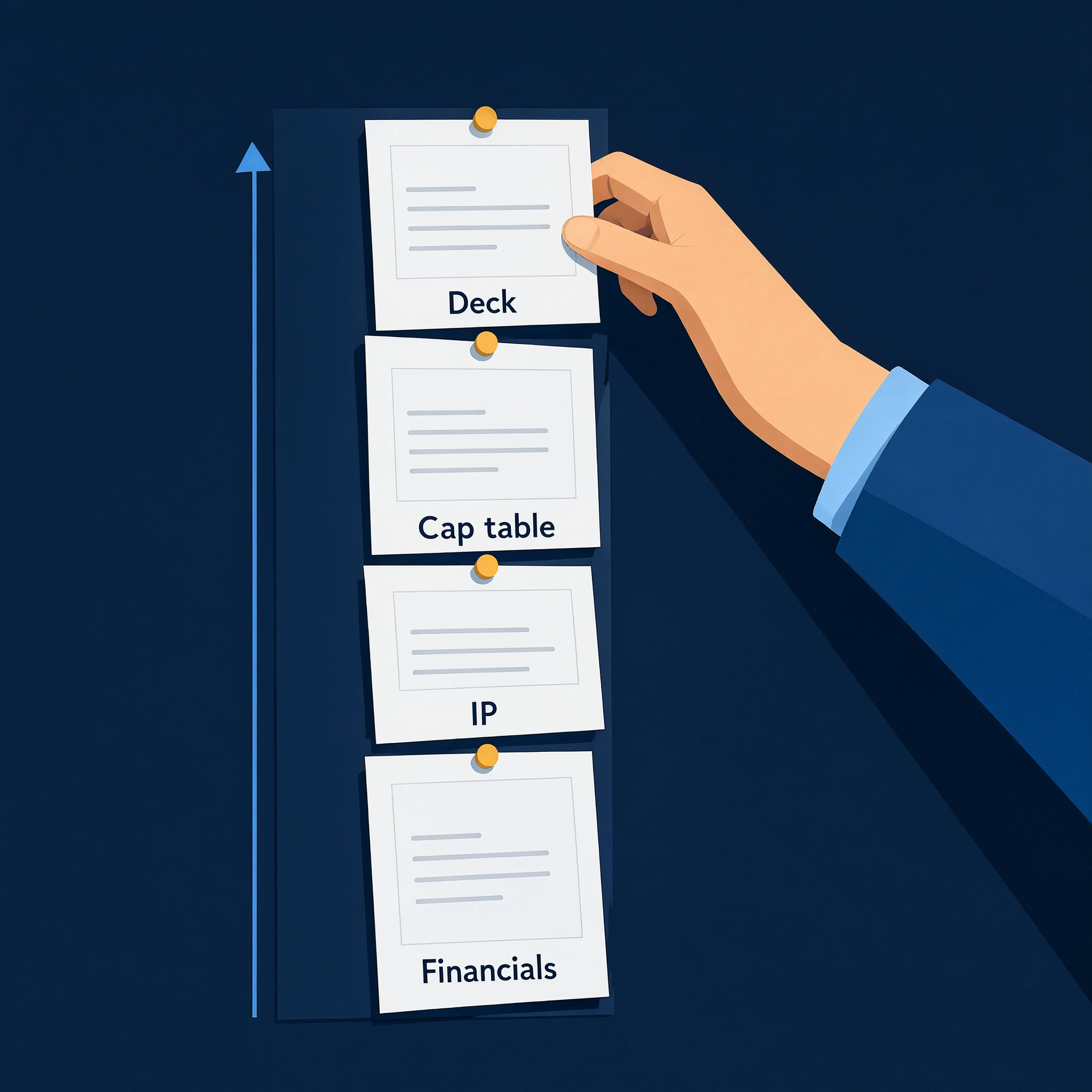
The checklist tells you what should exist. It does not tell you how the pieces read together, which is where an outside structured analysis earns its place. Running a DDScore analysis on your current materials before diligence gives you a written report with an overall 0 to 100 score, a score and analysis-confidence figure for each of twelve dimensions, and strengths, areas for development, risks, and evidence limitations set out by dimension.
The useful step is sorting. Take each finding and place it in one of three columns: "poorly told," meaning the work is done but your materials do not show it, so fix the materials; "not addressed," meaning the gap is real, so build it into the business plan; or "needing deeper background," meaning there is a reason you have not stated, so investigate before you act. The decision rule is conditional rather than exclusive. Findings labeled "poorly told" change what you send an investor. Findings labeled "not addressed" change your plan and your timeline. Findings labeled "needing deeper background" change nothing until you verify whether the finding is even true and whether you can influence the underlying cause; once verified, that finding may turn out to be a communication problem, a business change, or a fact you simply disclose and explain. Findings move between columns as evidence arrives, and sorting them again after new information is part of the exercise.
The report also produces questions tied to the evidence gaps and risks that matter for further human review, which gives you a head start on the questions an outside reviewer may raise, without telling you which ones they will actually ask. You can run the analysis again on updated materials later to compare how the evidence and gaps changed. What it does not do is audit your accounts, certify your claims, or promise that a round will close. It is analytical input for your judgment and your advisors, and the decision stays with the people who write the check and the founders who run the company.
Explore DDScore for Founders · Explore DDScore for Investors