
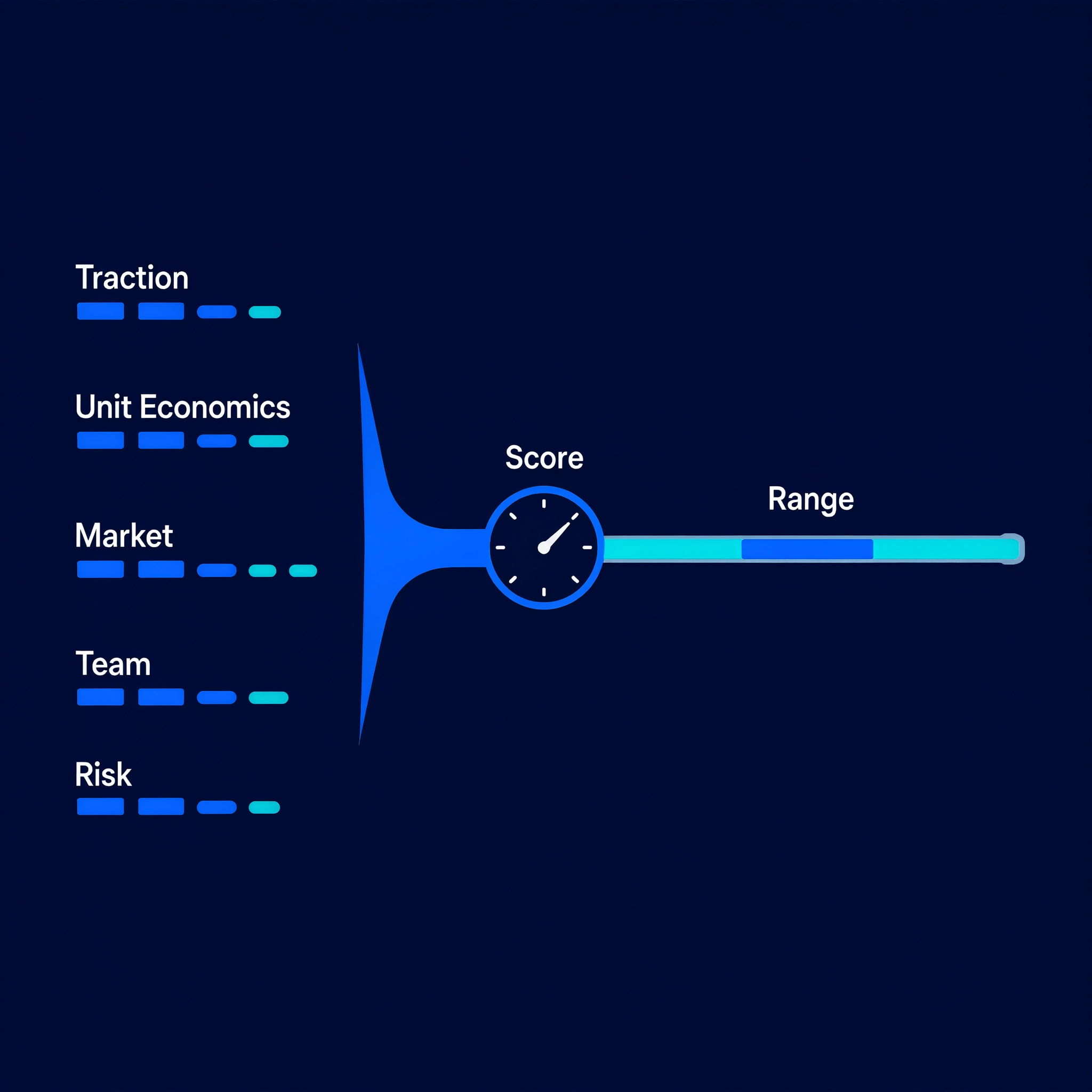
The short answer: evaluate an early-stage startup by screening it quickly, then gathering evidence on traction, unit economics, market, team and risk, and finally converting those findings into a structured score and a range estimate for a stated outcome, unit and time horizon rather than a single number. That order matters. Early-stage companies have limited performance history, so the quality of your evidence, not the polish of the pitch, determines how much weight each finding can carry. This article walks through the sequence, explains what each step should produce, and shows how the findings connect to a comparable score and a range you can defend before an investment committee.
How Do I Evaluate a Startup Investment?
Start with a screen, not a spreadsheet. At the earliest stages there is little operating history to analyze, so this article works from team quality, market size, product evidence and early signs of customer interest before it attempts any valuation work. That ordering is this article's chosen method, not a rule that valuation methods only become meaningful once these inputs are assessed. A valuation approach can be run at any point, and its output inherits whatever evidence supports it. The sequence below is screen, gather evidence, judge, then estimate a range.
The sequence is ordered so that each step supplies the input the next step needs. Traction tells you whether anyone wants the product. Unit economics tells you whether growth helps or hurts. The market tells you whether the outcome can be large enough. The team tells you whether this group can execute. Risk findings tell you what could break the case. Only after those five are assessed do a structured score and a range estimate mean anything, because a number without stated reasons cannot be challenged, compared or updated. Two labels stay separate from start to finish: how the case looks in each area as presented in the materials submitted to you, and how much confidence your evidence supports. A range estimate also needs a defined outcome, a unit and a time horizon before it means anything, and because valuation is forward-looking, any estimate rests on assumptions about the future rather than on measured history.
A useful discipline throughout is to keep three things separate in your notes: the evidence you collected, your interpretation of what it implies, and the decision you are leaning toward. Conflating them is how a persuasive narrative ends up carrying more weight than the underlying facts. The checklist at the end of this article keeps those three columns intact.
Step 1: Run a Five-Minute Screen Before Deeper Work
Most opportunities should be filtered before any serious work begins. A short screen asks whether the premise can be explained in one sentence, whether the timing is plausible, whether the deal fits your circle of competence, and whether you can afford the loss. If the basic premise cannot be stated plainly, that is usually a signal that the thinking has not been clarified yet.
This step is about protecting your review time. A screen that rejects weak fits early leaves capacity for the cases that deserve customer calls, reference checks and financial scrutiny. It also prevents a common failure mode among new investors: spending hours modeling a company before establishing whether the fundamentals warrant it.
Evidence to request: a one-paragraph description of the product, the customer and the problem, plus the current round terms. Red flag: the premise changes every time it is explained, or the terms are unavailable at this stage. Output: a go or no-go note with one sentence of reasoning.
Step 2: Assess Traction and What the Evidence Actually Proves
Traction at the early stage is about signs of customer interest, and the form of that evidence varies. Waitlist signups, letters of intent and first paying customers are not equivalent signals, and treating them as interchangeable is one of the fastest ways to overstate a case. One checklist of common investor heuristics states a preference for one paying customer over 100 free users, on the reasoning that payment demonstrates willingness to pay. That preference is a useful prompt, not a universal rule: its force depends on the business model, the price point, the stage of the company and what the free users are actually being used to prove.
Assess traction for what it proves rather than how it is described. Ask what the sales cycle looked like, what objections came up, and whether customers use the product repeatedly. Retention and cohort behavior can tell you more than a headline growth figure when the business model depends on repeat use. For a long-cycle enterprise sale or a single-transaction product, different evidence carries the weight, so match the metric to the model. Keep three states separate when payment matters: a signed contract shows what the parties agreed, an invoice shows that the company billed the amount, and only a settlement record such as a bank statement or payment-processor extract shows that money arrived. Invoices verify billing; they do not verify receipt.
Evidence to request: customer list with contract status, a sample contract, a sample invoice, a settlement record for at least one payment, pipeline with stage definitions, and any retention or usage data the company actually has. Red flag: traction described only in aggregate terms such as "strong interest," with no named customers and no way to distinguish a signed deal from a conversation. Output: a traction note that classifies each signal by what it proves, separates billing from settlement, and flags what is unverified.
Step 3: Assess Unit Economics: Does Growth Help or Hurt?
Unit economics answers one question: when the company sells one more unit, does its financial position improve or deteriorate? At the early stage you will rarely have clean numbers, so the task is to establish whether the direction is understood at all, not to audit a finished model.
Start with the components the company claims: price, cost to deliver, cost to acquire a customer, and the lifetime value that follows. Ask how each figure was derived and whether it rests on measured data or on assumptions. A gross margin that improves with volume suggests a model that scales; a cost structure where each additional customer requires proportional headcount suggests one that does not. Neither is automatically disqualifying, so compare the numbers against the model the company is actually running.
The most useful early-stage question is often about direction rather than level: does the company know whether its economics improve as it grows, and has it checked that belief against real transactions? Record the four components as separate lines. Price is often the earliest to become inspectable, because a signed contract states what the customer agreed to pay. Keep two kinds of shortfall apart from here on: a figure the company states about its current economics with no record to check it is an unsupported claim, while a figure that does not exist yet is missing evidence. The first can be tested and was not; the second is a request.
Evidence to request: pricing sheet, unit cost breakdown, customer acquisition spend with the results it produced, and a cash flow or runway statement. Red flag: growth projections that require margins to expand with no stated mechanism, or a cash bridge whose ending balance does not reconcile with the stated burn. Output: a unit economics note stating what is measured, what is assumed, and which single assumption, if wrong, breaks the model.
Step 4: Assess the Market and the Competition
The market step asks whether a successful outcome could be large enough to matter, and whether the company's share of that market is plausible from where it stands today. Market size claims in pitch materials are frequently built from broad category figures, so the work is to reduce a large number to a reachable one: which segment, which buyer, which geography, and what share of that segment the plan requires.
Then test the plan against the segment. A year-five target that implies winning a large share of a national market from a standing start is a finding, not a forecast. Ask what evidence supports demand in the specific segment, how the company reached its current customers, and whether the same motion repeats.
Competition belongs in this step because it constrains both price and share. Look for direct competitors, platform features that could substitute for the product, and the customer's existing alternative, which may be doing nothing or doing the work in-house. A deck that names no competitor is not evidence that none exist; it is an open question. External checks against current public information can identify alternatives the materials omit, though such checks depend on what public sources are available and are not exhaustive market research.
Evidence to request: the market sizing model with its assumptions, a list of the top ten customers or accounts, win and loss notes, and the company's own competitor list. Red flag: a top-down market figure with no bottom-up bridge, or differentiation claims that a competitor's public materials would contradict. Output: a market note stating the reachable segment, the share the plan requires, and the alternatives customers use today.
Step 5: Assess the Team's Capacity to Execute
At early stages the team can be the strongest asset and the largest single point of failure, so the assessment is specific rather than reputational. Map the plan's requirements against the people actually in place: which roles the plan depends on, who fills them today, and where one person is carrying several critical responsibilities.
For each key person, ask what they have personally done before, at which company, at what scale, and for how long. Backgrounds that check out in general but do not match the specific challenge in front of the company are a finding worth recording. Also ask about capacity directly, because role coverage alone does not establish it. Capacity shows up in evidence: current workload, prior experience at the scale the plan requires, hiring lead time and cost against runway, and whether the plan assumes help that has not been hired.
Evidence to request: short bios with dates and roles, an org chart or role list, hiring plan tied to milestones, and references from people who worked with the key individuals directly. Red flag: a critical role in the plan that nobody currently fills, or a key-person dependency with no stated continuity plan. Output: a team note listing matched capabilities, capability gaps, and the roles the plan assumes but the company does not have.
Step 6: Identify the Material Risks That Could Break the Case
Risk assessment is where the previous four steps are stress-tested together. List what would have to be true for the investment to work, then ask which of those conditions currently rest on thin evidence. The risks that matter are the ones that would change the outcome, not the ones that are easy to write down.
Group risks by type so they do not blur together: market risk (demand does not appear), execution risk (the team cannot deliver), financial risk (runway runs out before the next milestone), competitive risk (a substitute wins), and legal or regulatory risk (the business cannot operate as planned). For each, record the evidence behind the concern and whether it is a supported finding or an unanswered question. A contradiction between two documents is a supported concern; a missing document is a gap that needs a request. Where a risk can be quantified from the materials, state the basis of the figure. Where it cannot, say so rather than attaching a number that has no source.
Evidence to request: the use-of-funds plan with milestones, the cap table and any shareholder terms, regulatory or compliance notes relevant to the sector, and the company's own risk list. Red flag: a plan whose milestones all fall after the runway ends, or risks the company lists but has not costed. Output: a risk register with severity (High, Medium or Low, judged by how much the item would change the outcome if it materialized), evidence status and the specific question that would resolve each item, plus a statement of which plan the rating covers: the funded plan in the use-of-funds document, not an illustrative scenario you construct later.
Step 7: Record Evidence Confidence Separately from the Case Quality
Before judging, assign an evidence confidence level to each material component in the five areas, then roll those components up to one label for the area. Confidence describes the quality and completeness of the evidence you saw. It does not rate the investment case; that is a separate judgment recorded in Step 8.
Four labels, defined before you review the first deal and kept fixed across deals. High means a record confirmed outside the company's own materials, such as a counterparty confirmation, a public record, or a settlement record that agrees with the company's figure, with everything internally consistent. Medium means specific records from the company that you inspected and found internally consistent, with no confirmation outside the company's own document set. Low means an assertion with no supporting record, records that exist but do not answer the question, or a record you inspected that is no longer available, so the finding rests on your inspection note. Not established means nothing was provided and nothing was asserted, or the data cannot exist yet because the company has not reached the point where it would. High is deliberately narrow, which is why a clean, internally consistent set of company records tops out at Medium.
Roll component confidence up to the area by taking the lowest label among its material components, and name the component that sets it. The rule is deliberately conservative: an area conclusion that depends on a component you cannot evidence is not well evidenced, even when the rest of the area is documented. Keep the component breakdown in the note so a reader can see which parts are solid and which are not.
This step prevents a common error: treating missing evidence as a weak case. A gap in the materials is a request, not a verdict, and a contradiction or an adverse finding is a finding. Output: for each material component, one line of evidence, one confidence label, and one open question, then one area confidence label with the component that sets it.
Step 8: Convert the Findings into an Overall Judgment
A score is a compression of your written findings, so write the findings first. Its purpose is comparability across opportunities and traceability back to reasons, not precision. What follows is a judgment, not a formula: no weighting scheme, point table or override rule can substitute for the reasons you write down, and a numerical scheme would imply a precision the underlying evidence does not support.
Two labels are recorded for each area and they answer different questions. Evidence confidence from Step 7 rates the evidence. The case rating rates the investment case in that area as it was presented in the materials submitted to you. Four case labels are enough, defined before you look at the first deal and kept fixed: Strong, where the claims are supported by records you inspected, everything is internally consistent, and no material adverse finding or material open question remains; Adequate, where the documented evidence supports the claims but a specific question stays open or one component is weaker than the rest without undermining the area; Weak, where the case as presented does not hold up where evidence exists, whether because a documented position is adverse or because the company stated a figure and supplied no record to check it; and Not established, where nothing was provided, nothing was asserted, or the data cannot exist yet, which is a request rather than a rating of the business.
How to weigh them is a matter of judgment applied consistently. Write the component findings first, then let the weakest evidenced part of an area carry the most weight in its label, because an area conclusion resting on a component you could not check is not well evidenced. Name every unsupported component as an open question: an open question can lower a judgment but never raise it, and a material open question keeps Strong out of reach. Keep the two labels side by side, because a gap in the materials is a request while a documented adverse position is a finding, and neither should be read as the other.
State your priorities before you score, because changing them after seeing a result is how a score becomes a rationalization. An illustrative set for a seed-stage B2B software mandate, to adapt to your own: traction and team carry the highest priority, since at seed the case rests on early demand and on the people who must produce it; market follows, because a reachable segment has to exist for the outcome to matter; unit economics carries lower priority at seed because the inputs are early, though a break in the model still matters; and risk acts as a gate rather than a weight, so a Weak risk judgment triggers a stop-or-restructure discussion regardless of the other four.
Record the result as one sentence that names the five areas and points to a consolidated record of every open question, so a reader can reach each question from the summary. When you update a case, note why a judgment changed: new evidence arrived, or the materials themselves changed. Only new evidence is stronger support, and comparisons between reviews are made component by component rather than by area label, because two areas that read the same can rest on different evidence. The score never stands alone; the reasons are what you present.
Step 9: Produce a Cautious Range Estimate for a Stated Outcome
A range estimate is a bounded statement of plausible outcomes for a defined quantity, under explicitly stated assumptions. Before you produce one, write down three things: what is being estimated, in what units, and over what horizon. Without those, a range is a shape rather than an estimate. It is not a prediction, a price target, or a valuation formula, and at the early stage it cannot be more precise than the evidence feeding it. Building it is a judgment, not a calculation that decides anything.
Build the bounds through a stated chain instead of by picking two numbers. Each link is an assumption, and each link names which assessment feeds it: the operating outcome at the horizon, built from what the evidence verifies and what the plan says will convert; company value at that horizon, under an assumed multiple you define for your own method; your ownership, which depends on entry terms and on dilution from later rounds; your cash proceeds; and finally the proceeds multiple, which is a ratio and not the same quantity as the money. Write each link's inputs on the page and label where each one comes from, and state what your method omits, such as transaction costs, taxes and escrow.
Turning a company value into cash for your shares runs through two separate stages, and each needs its own statement on the page. The first is the bridge from enterprise value to equity value: enterprise value prices the operating business, so debt and other senior claims are deducted because they are settled before anything reaches the equity, cash and cash-equivalent balances are added because they belong to the company rather than to its lenders, and any other relevant bridge item for the case, such as leases or other claims that rank ahead of or sit outside the equity, is named with its direction. The result is equity value, and each adjustment you include, exclude or cannot source belongs on the page. If your multiple is applied so that its output is already read as equity value, say so, because an undefined company value cannot be converted into a per-share outcome. The second stage does not adjust the value: it allocates the equity value the bridge produced among shareholders under the share-class rights recorded in the cap table and shareholder terms, where preferences, participation rights and conversion terms decide who receives what. Proportional distribution, in which every share receives proceeds in proportion to ownership, is one possible result of those rights rather than a precondition for the analysis. Where the rights are unknown, record that as an open item instead of assuming a mechanism, and read the terms before writing a proceeds figure.
Let the five assessments constrain which assumptions you are allowed to write down. The conservative bound should rest on what the contracts and records document. The favorable bound should use the conversion and growth stated in the company's own plan, traced to that plan rather than supplied by you; where no plan input exists, substitute your own figure and label it a placeholder, because a placeholder carries no more weight than the reasoning behind it. Where an assessment cannot support its link, say so instead of borrowing precision from another link: traction caps what is contracted and what may be assumed to convert, unit economics determines whether a margin mechanism can be stated at all, market sets whether the customer counts fit a reachable segment, team sets whether the volume can be delivered, and risk and runway set whether the plan is funded.
Include a failure scenario alongside the bounds. At the early stage the downside is not a slightly lower number; it is the possibility of receiving nothing back, and verified contracts do not create a floor. State the share-treatment assumptions that turn ownership into cash, and keep two zero situations apart: the company fails and the investment is lost, or the company is still operating with no liquidity event by the horizon, which is delayed liquidity with the position still held. Three qualifications belong with every range: it depends on entry terms, it depends on future financing and dilution, and it is conditional on the assumptions listed. Read the width only next to the scenario list, because width describes how far apart the scenarios you chose are, not how good the evidence is. Present the range with its assumptions attached, state the width plainly rather than hiding it behind a midpoint, and be ready to name which assumptions each bound rests on, including the ones both bounds share, such as a cash liquidity event within the horizon.
A Hypothetical Worked Example
The following is a hypothetical example created for this article. It does not describe a real company, and its figures are illustrative rather than benchmarks. All money figures are in euros (EUR).
Scenario: a seed-stage B2B software company raising a seed round. You work through the steps in order, and every label below is applied by the rules in Steps 7 and 8. Screen: the premise fits in one sentence, the deal fits your mandate, and the loss is affordable, so you proceed.
Traction: four customers on annual contracts, contract copies inspected (Medium). No invoice or settlement record was provided, so receipt is not established (Not established). A pipeline of twelve conversations with stage definitions is specific and internally consistent but unconfirmed outside the company's materials (Medium). The contracts are in their first term, so no renewal outcome exists yet (Not established), while usage during the term can be requested now and none was provided (Not established). Area confidence: Not established, set by the settlement record. Case rating: Adequate. The contracts and pipeline support the claims as presented and no documented position is adverse; settlement, usage, renewal and repeatability are open questions (OQ-1, OQ-2, OQ-3, OQ-14), and open questions can lower a rating but never raise one, so Strong is out of reach.
Unit economics: price is documented at EUR 100,000 per contract per year across the four contracts (Medium). Gross margin is stated as a current figure with no cost record supplied to check it: Weak as a finding, Low as evidence. Acquisition cost and lifetime value were never supplied and no figure was asserted for either (Not established). Area confidence: Not established, set by customer acquisition cost. Case rating: Weak, because the weakest evidenced component carries the most weight and the company stated a margin figure it did not support. Price does not rescue the area: it is one supported component of four. The margin claim is a Weak finding because it was made and not evidenced; acquisition cost and lifetime value are requests (OQ-4, OQ-5, OQ-6).
Market: a specific reachable segment with a bottom-up figure in the sizing model (Medium), and a year-five share of that segment that is forward-looking and rests on weaker evidence (Low). The note records that a bottom-up figure exists but not the segment size, so the customer counts used in the range cannot be tested against a reachable-segment number (OQ-7). Repeatability of the sales motion beyond four accounts is recorded under traction (OQ-3). Area confidence: Low, set by the year-five share assumption. Case rating: Adequate: the segment definition is documented and internally consistent, the share assumption is a plan input rather than a current claim lacking a record, and OQ-7 keeps Strong out of reach.
Team: two founders with directly relevant prior experience in dated bios (Medium), and a role list documenting one open engineering role the plan depends on (Medium). References from people who worked with the founders directly were not taken (Not established), and capacity evidence was not supplied (Not established). Nothing here establishes that the team can serve the fifteen-contract volume assumed in the favorable bound, so the range carries that as an open link (OQ-9). Area confidence: Not established, set by the reference evidence. Case rating: Adequate: the bios support the capability claims as presented, the unfilled role is a documented gap rather than an adverse position, and OQ-8, OQ-9 and OQ-10 keep Strong out of reach.
Risk: runway covers the funded milestones with a small buffer and reconciles with the stated burn, though both figures are company-prepared (Medium). The largest supported concern is customer concentration: four similar contracts, so losing one removes about a quarter of contracted revenue, a figure taken from the contracts themselves with no probability attached (Medium). Distribution terms were not inspected (Not established), and legal or regulatory coverage was neither supplied nor asserted (Not established). Area confidence: Not established, set by distribution terms and legal or regulatory coverage. Case rating: Adequate: the funded milestone plan survives as written, concentration tolerance is unresolved (OQ-11), and reconciling the cash figures to bank records is open (OQ-12). The two Not established components are requests rather than adverse findings, so they keep Strong out of reach without making the area Weak. The risk gate is not triggered, because it triggers on a Weak risk rating. The growth scenario used below sits outside this judgment because the company never proposed it; its funding line is recorded as a condition on the range (OQ-13).
Risk register with severity: customer concentration, High, evidence Medium, resolving question OQ-11. Runway and burn reconciliation, Medium, evidence Medium, OQ-12. Funding of the illustrative growth scenario, High within that scenario, evidence Not established, OQ-13, outside the funded plan. Distribution terms, Medium, evidence Not established, OQ-15. Legal and regulatory coverage, Medium on impact if a constraint materialized rather than on any known exposure, evidence Not established, OQ-16.
Evidence confidence across the five areas: traction Not established (settlement), unit economics Not established (customer acquisition cost), market Low (year-five share assumption), team Not established (references), risk Not established (distribution terms and legal or regulatory coverage). No area reaches High, because High requires confirmation outside the company's own materials and none was obtained. The highest any single component reaches is Medium, on the company-prepared runway and burn figures and on the concentration figure inside risk.
Overall judgment: the two highest-priority areas, traction and team, are Adequate rather than Weak, market is Adequate, and risk is Adequate despite carrying the lowest confidence label, so the risk gate is not triggered and the pattern reads as a case worth continued diligence rather than a failed one. Unit economics is Weak: one component is documented, one is stated without a record, and two were never supplied. Under the priorities in Step 8 that does not stop the review by itself, but it is the area that has to be tested before the case can be presented as sound. It does not explain the conservative bound below: that bound comes from the revenue and multiple assumptions the range section names, and what the Weak rating does is deny any claim that margin evidence supports the value.
Score line, one sentence as Step 8 requires: traction Adequate with confidence Not established (settlement), unit economics Weak with confidence Not established (customer acquisition cost), market Adequate with confidence Low (year-five share assumption), team Adequate with confidence Not established (references), risk Adequate with confidence Not established (distribution terms and legal or regulatory coverage), which reads as a case worth continued diligence, with no area at High confidence and sixteen open questions recorded below.
Consolidated open-question record, part one. OQ-1 traction: were the four contracted amounts received? Evidence: a bank statement or payment-processor extract. OQ-2 traction: do the four first-term contracts renew? Evidence: the renewal outcome, which cannot exist yet; revisit at the renewal date. OQ-3 traction, also bearing on market: does the sales motion repeat outside the founding network? Evidence: a customer won without founder involvement, with win notes. OQ-4 unit economics: what delivery cost stands behind the stated gross margin? Evidence: cost records. OQ-5 unit economics: what did it cost to win the four customers? Evidence: acquisition spend with the results it produced. OQ-6 unit economics: what lifetime follows from these contracts? Evidence: renewal outcomes, which cannot exist yet at first term, plus usage and expansion evidence gathered during the term.
Part two. OQ-7 market: what evidence supports the year-five share, and what is the reachable segment size against which the customer counts in the range can be tested? Evidence: the segment size from the sizing model, segment demand evidence, and a bottom-up conversion path behind the share. OQ-8 team: references from people who worked with the founders directly. Evidence: reference calls. OQ-9 team: capacity at the scale the plan requires. Evidence: current workload, hiring lead times and cost against runway. OQ-10 team: who fills the open engineering role, and by when? Evidence: a named hire or a plan adjustment. OQ-11 risk: what customer concentration does the funded plan tolerate? Evidence: a stated tolerance and mitigation. OQ-12 risk: do the company-prepared runway and burn figures reconcile to bank records? Evidence: bank statements and a cash reconciliation. OQ-13 risk, outside the funded plan: is the illustrative growth scenario funded? Evidence: a use-of-funds plan that carries the acquisition cost, or a stated financing plan.
Part three. OQ-14 traction: what does usage during the first contract term show? Evidence: usage or engagement data from the company's own systems, which can be requested now. OQ-15 risk and fundability: do debt, senior claims or liquidation preferences sit ahead of this position? Evidence: the cap table and shareholder terms, which were not inspected in this example. OQ-16 risk: do any legal or regulatory obligations apply, and does the funded plan accommodate them? Evidence: sector regulatory or compliance notes, or a documented statement that no material requirement applies, checked against current public information for the sector.
Range: the outcome is cash proceeds to the investor seven years after investment, in EUR, expressed both as a money amount and as a multiple of the EUR 500,000 invested, on hypothetical entry terms of EUR 500,000 for 10 percent, which implies a post-money valuation of EUR 5,000,000. The chain is the one Step 9 sets out: operating outcome at the horizon, company value under an assumed multiple, ownership after dilution, cash proceeds, then the proceeds multiple. This example defines its own multiple convention, company value at the horizon as a multiple of annual revenue at that horizon, because a multiple means nothing until its base is named. Every multiple below is a reviewer placeholder, not a market benchmark. The value in the chain is equity value: the multiple is applied to revenue so that its output is read as the value of the company's equity at the horizon, with no debt or enterprise-value bridge modeled. Cash proceeds then apply the two stages of Step 9 as a hypothetical simplification: no debt or senior claim is modeled, so equity value reaches shareholders intact, and all shares are assumed to participate in proportion to ownership. No cap table or shareholder terms were inspected, so the share-class rights are assumed rather than verified (OQ-15).
Conservative bound: revenue at year seven is EUR 400,000, the four contracts at EUR 100,000 renewed at the current price with no increase. Renewal is an assumption, because retention does not establish it (OQ-2). Company value at 2.0 times that revenue is EUR 800,000. Ownership is 7.5 percent, the original 10 percent reduced by one future round in which the investor does not participate and which issues shares reducing existing holdings by a quarter. Cash proceeds are 7.5 percent of EUR 800,000, which is EUR 60,000, and the proceeds multiple is EUR 60,000 against EUR 500,000 invested, or 0.12 times. This bound rests on what the contracts and records document, plus the renewal and multiple assumptions those records do not cover. The revenue base is capped by traction: four contracts at the contract price, with no evidence that the motion repeats beyond them (OQ-3).
Favorable bound: revenue at year seven is EUR 1,500,000, from the four renewals, six of the twelve pipeline conversations converting, and growth to fifteen contracts through the same sales motion. Conversion and customer growth are reviewer placeholders rather than company plan inputs, and price stays at EUR 100,000. Company value at 6.0 times that revenue is EUR 9,000,000. Ownership is 6.4 percent, the original 10 percent reduced by two further rounds, each issuing shares that reduce existing holdings by a fifth, which is 10 percent times 0.8 times 0.8. Cash proceeds are 6.4 percent of EUR 9,000,000, which is EUR 576,000, and the proceeds multiple is about 1.15 times. The growth also requires acquisition spend that the stated use of funds does not carry, so this bound keeps the funding condition: it needs either that cost or the second financing round already assumed in the ownership link. Conversion of six pipeline conversations and growth to fifteen contracts are reviewer placeholders with no repeatability evidence behind them (OQ-3).
Which findings constrain which link. Traction caps the revenue base: four contracts at EUR 100,000 are documented, the pipeline is specific but unconfirmed, and repeatability is open (OQ-3), so the conservative bound uses only the four and the favorable bound's conversions are placeholders. Unit economics is Weak, so no margin mechanism can be stated and the chain runs through a revenue multiple instead; the rating does not produce the conservative revenue figure or the 2.0 multiple, both selected assumptions, and the conservative value landing below the entry post-money is a consequence of those selections, not of the rating. Market records a bottom-up figure but no segment size, so neither customer count can be tested against a reachable segment (OQ-7). Team capacity at those volumes is not established (OQ-9). Risk funds only the funded plan, so the favorable bound's growth carries an acquisition cost the use of funds does not carry (OQ-13). Two links therefore remain unestablished: whether the customer counts fit a reachable segment, and whether the team can serve them.
Two zero-cash scenarios sit beside the bounds, and they are not the same event. In the first, the company fails before year seven and the investment is lost: cash proceeds EUR 0, proceeds multiple 0 times, the EUR 500,000 gone. In the second, the company is still operating at year seven with no acquisition, listing or other liquidity event: cash proceeds EUR 0 and proceeds multiple 0 times on cash, but the position is still held rather than written off. The first is a loss; the second is delayed liquidity. Verified contracts do not create a floor, so neither scenario is excluded by the four signed contracts. Both are selected fallback scenarios written down to show the shape of the downside; neither is derived from an evidence gap, which produces an open question resolved by a request rather than a zero.
Share treatment and distribution assumptions: proceeds assume the entire position is sold for cash in a single liquidity event at the stated company value and, as a hypothetical simplification, that all shares participate in proportion to ownership with no debt, senior claim or liquidation preference ranking ahead of this position (OQ-15), and with no escrow, no earn-out, no acquirer stock, no partial sale, no transaction costs, no taxes and no delay past the horizon. If any of those differ, cash at year seven differs from the figures above. Transaction costs, taxes and escrow are omitted rather than buried in the figures.
Width and sensitivity: the range runs from EUR 60,000 to EUR 576,000 in cash, and from 0.12 times to about 1.15 times on the invested EUR 500,000, a spread of about 1.03 multiple points. The width describes how far apart these two chosen scenarios are, not how good the evidence is. Move one assumption at a time. On the conservative bound, the four renewals are the entire revenue base, so removing them while holding the multiple at 2.0 and ownership at 7.5 percent fixed leaves revenue of EUR 0 under the bound's own construction, proceeds of EUR 0 and a multiple of 0 times. That is the arithmetic of a bound built only from those four contracts, not a conclusion drawn from missing evidence. If no future round occurs and the stake stays at 10 percent, proceeds are EUR 80,000, or 0.16 times; if the multiple is 3.0 rather than 2.0, proceeds are EUR 90,000, or 0.18 times. On the favorable bound, the four renewals are one input among several, so their loss does not collapse it: holding the multiple at 6.0 and ownership at 6.4 percent fixed and assuming no replacement customers for the four, the fifteen-contract total becomes eleven contracts, revenue EUR 1,100,000, value EUR 6,600,000 and proceeds EUR 422,400, or about 0.84 times. That is one assumption moved while the others stay fixed. If the multiple is 4.0 rather than 6.0, proceeds are EUR 384,000, or about 0.77 times; if twelve contracts are reached rather than fifteen, revenue is EUR 1,200,000, value EUR 7,200,000 and proceeds EUR 460,800, or about 0.92 times; if the stake is 8 percent rather than 6.4 percent, proceeds are EUR 720,000, 1.44 times.
Three qualifications travel with the range: it depends on the entry terms of EUR 500,000 for 10 percent, it depends on the future financing assumed in the ownership link, and it is conditional on every placeholder listed above. The renewal sensitivity shows a narrower result: removing the four renewals eliminates the conservative bound's revenue base, while the favorable bound keeps its other assumed customers and falls to about 0.84 times. Both bounds also rest on a shared assumption, a cash liquidity event within the seven-year horizon, and without one both return EUR 0 in cash while the position is still held, as the zero scenario above sets out. Renewal of the four contracts (OQ-2) is therefore the first thing to verify for the conservative bound, not a single key to the whole range. The range uses conditional, hypothetical equity values at the horizon, which are not an established current valuation of the company. It states what the evidence and the labeled assumptions produce, so that the assumptions can be argued with, and the width is meaningful only next to the scenario list and the sensitivity lines.
Decision: proceed to deeper diligence on the open questions above, including a record showing the four contracted amounts were received (OQ-1), usage data from the first contract term (OQ-14), delivery-cost records that would let the stated gross margin be tested (OQ-4), the actual cost of winning the four customers (OQ-5), references from people who worked with the founders directly (OQ-8), the concentration level the funded plan tolerates (OQ-11), the sector's legal and regulatory requirements (OQ-16), and the cap table and shareholder terms behind the proportional distribution assumption (OQ-15). They do not by themselves support an investment decision, which remains yours and depends on terms, portfolio fit and the answers you get.
The Final Checklist
Use this before any committee conversation. Each line produces a written output you can hand to someone else.
1. Screen: premise in one sentence, mandate fit, affordable loss. Output: go or no-go with one reason.
2. Traction: each signal classified by what it proves, billing separated from settlement, unverified items listed. Output: traction note.
3. Unit economics: price, delivery cost, acquisition cost and lifetime value recorded as separate lines, measured versus assumed figures separated, the single assumption that could break the model named. Output: unit economics note.
4. Market and competition: reachable segment, required share, current customer alternatives. Output: market note.
5. Team: plan requirements mapped to people, capability gaps named, capacity assessed from evidence rather than role coverage. Output: team note.
6. Risk: register with severity, evidence status and resolving question per item, plus a statement of which plan the judgment covers, meaning the funded plan rather than any illustrative scenario. Output: risk register.
7. Confidence: one evidence-confidence label per material component (High, Medium, Low, or Not established), rolled up to the area by the lowest label, kept separate from the case rating. A record you inspected that later becomes unavailable drops that component to Low with an inspection note. Output: component labels plus one area confidence line naming the component that sets it.
8. Judgment: one of four case ratings per area (Strong, Adequate, Weak, or Not established), rating the case as presented in the submitted materials, with priorities stated before scoring. Weigh the weakest evidenced component most heavily, name every unsupported component as an open question, and let open questions lower a judgment but never raise it. Output: a one-sentence summary naming the five areas and pointing to a consolidated open-question record in which every question appears, plus a note of why any rating changed between reviews: new evidence, or a change in the materials.
9. Range: defined outcome, units and horizon; the chain from operating outcome to value to ownership to cash proceeds to the proceeds multiple, with both a defined value basis (equity value, or a multiple applied so its output is read as equity value) and an explicit treatment of shareholder distribution rights (preferences, participation and conversion, or those rights marked unresolved), each assumption written down, each link named against the assessment that feeds it, and each input labeled as a company-plan figure or a reviewer placeholder; conservative bound, favorable bound, zero scenario with its distribution and share-treatment assumptions, and a sensitivity note for each assumption the width depends on, with any fallback scenario labeled as a selection rather than a derived result. Output: cash proceeds and the multiple as separate quantities, with the assumptions attached.
10. Separation check: confirm your notes still show evidence, interpretation and decision in three distinct places. Output: a record a colleague can challenge.
Conclusion: How to Use the Results
The output of this framework is not a verdict. It is a structured record: five assessed areas with their evidence, an evidence confidence level and a case rating for each, a score line that compresses the pattern without hiding it, a consolidated record of every open question, and a range for a stated outcome whose bounds trace back to assumptions you wrote down.
Use it in three ways. Before a committee or a co-investor discussion, read the score line, the open-question record and the risk register together, because the objections you will face live in the gap between them, and state which plan each risk judgment covers. When new information arrives, update the affected component and note whether the change came from new evidence or from a change in the materials; only new evidence is stronger support, and comparisons are made component by component rather than by area label. When you compare two opportunities, compare the patterns of ratings and the scenario lists behind the ranges rather than the headline summaries, since two identical-looking summaries can rest on very different evidence, and a narrow range can reflect narrowly chosen scenarios rather than strong evidence.
The discipline that makes this work is the one from the first section: keep evidence, interpretation and decision separate, keep the two labels apart, and keep every number attached to its reasons. A score you cannot explain is a number you cannot defend, and a range without a defined outcome and a stated assumption list is a guess with a border. The checklist above is designed so that neither can happen by accident.
Explore DDScore for Founders · Explore DDScore for Investors