
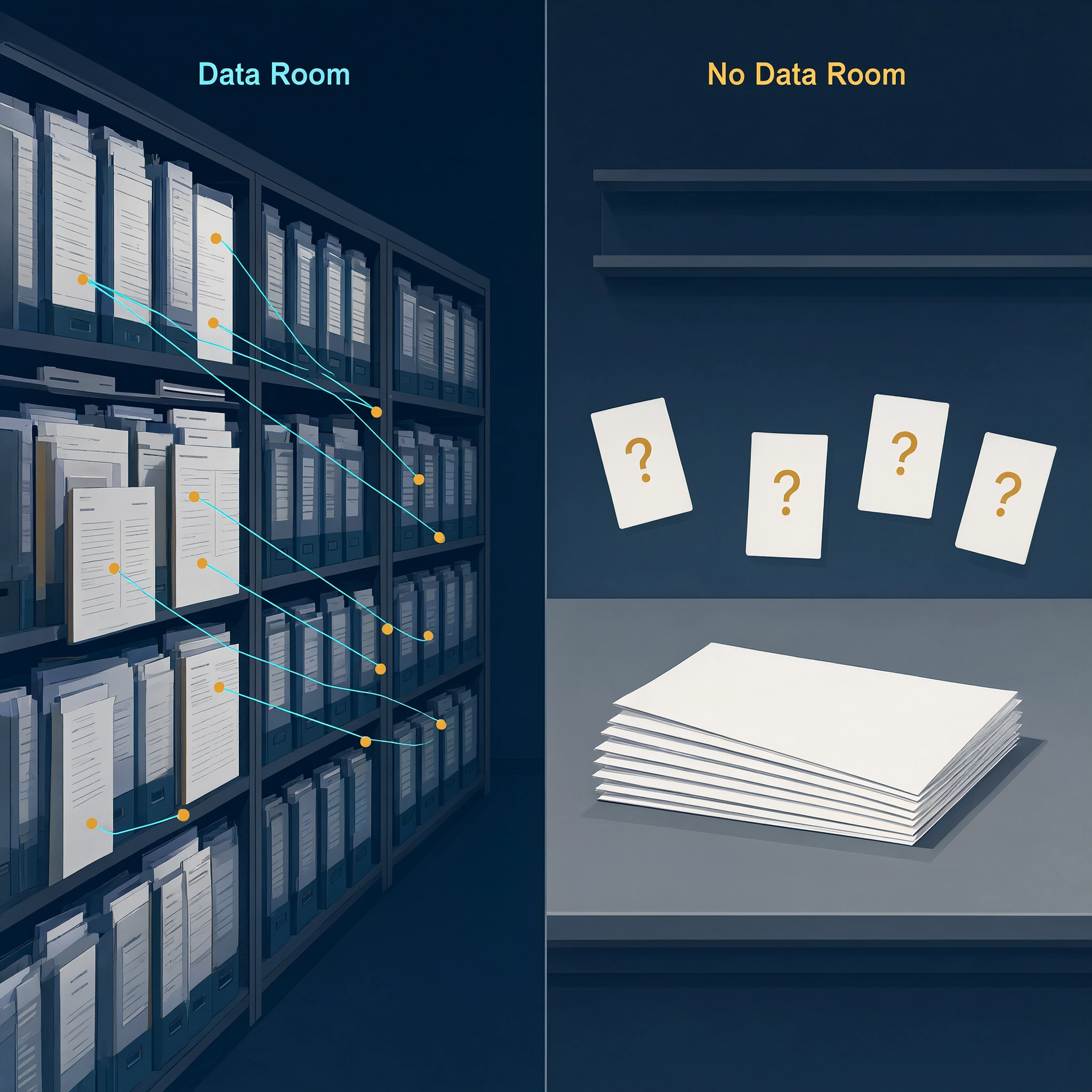
AI due diligence means using AI to read documents, extract clauses, flag anomalies and trace findings back to their sources. It works where a document population exists: a data room, a contract set, a general ledger, a sanctions list. In the document-review workflow, that coverage limit is the one that matters. A document that was never submitted cannot be examined, and the missing document itself can surface as an evidence gap rather than a clean result. AI due diligence does not decide whether a company is worth investing in, because that judgment rests on market, team, financial and financing questions that documents alone do not answer, and at the pre-seed stage those documents may be thin or absent. This article explains what each category of AI due diligence tools actually checks, where each one fits, and what an early-stage investor or a founder should do instead.
What Does Each AI Due Diligence Tool Category Actually Do?
Vendor roundups sort what the market calls AI due diligence into four lanes, and each lane is built around a different document population. Hebbia's published roundup compares ten platforms across four workflows: M&A, legal, financial, and compliance. That grouping and the count of ten are what the roundup's public description establishes. Fuller labels often attached to those lanes, such as M&A and deal intelligence, legal contract review, financial analysis and modeling, and compliance and AML screening, describe the same four kinds of work; the roundup's public description states only the four broad workflows. It does not assign individual platforms to individual lanes, so the comparison later in this article names specific platforms while treating each placement as a claim to confirm with the vendor rather than a fact this article has established.
Read the four lane names as descriptions of the work and the input each is built for. M&A work reads across a data room. Legal work reads an agreement set. Financial work reads ledgers and statements. Compliance and AML screening reads named people and entities against external lists. The concrete tasks usually associated with those lanes, such as extracting clauses from agreements, surfacing unusual ledger entries for a human look, or checking named entities against sanctions and watchlist sources, are illustrative of what the categories are for. They are not verified capability statements for any platform. What any individual platform can actually do inside its lane, how completely it does it, and how accurate the output is are per-vendor claims that a ranking page does not establish. No accuracy rate for any tool is established here. Verify the capabilities that matter to your deal with each vendor, on documents like yours.
Both Hebbia's roundup and Harvey's guide to AI-powered due diligence for M&A professionals are vendor-authored marketing content, and so is TechMiners' investor guide to tech due diligence in the age of AI. Their capability claims, time-savings figures and platform rankings are vendor statements, not independent measurements. Read the roundups as a map of what each lane claims, then verify the claims that matter to your deal.
A second meaning sits behind the same phrase. TechMiners' guide states that AI due diligence has two meanings: using AI to run a diligence process, and the tech diligence of an AI company's own models, data and claims. The first is a workflow. The second is a subject. They are separate exercises, and the second does not require adopting AI tools for the task. Assessing whether an AI startup's models, data and AI claims hold up requires the right questions and evidence about that company. The rest of this article is about the first meaning.
Is AI Due Diligence for Private Equity the Same as for a Pre-Seed Deck?
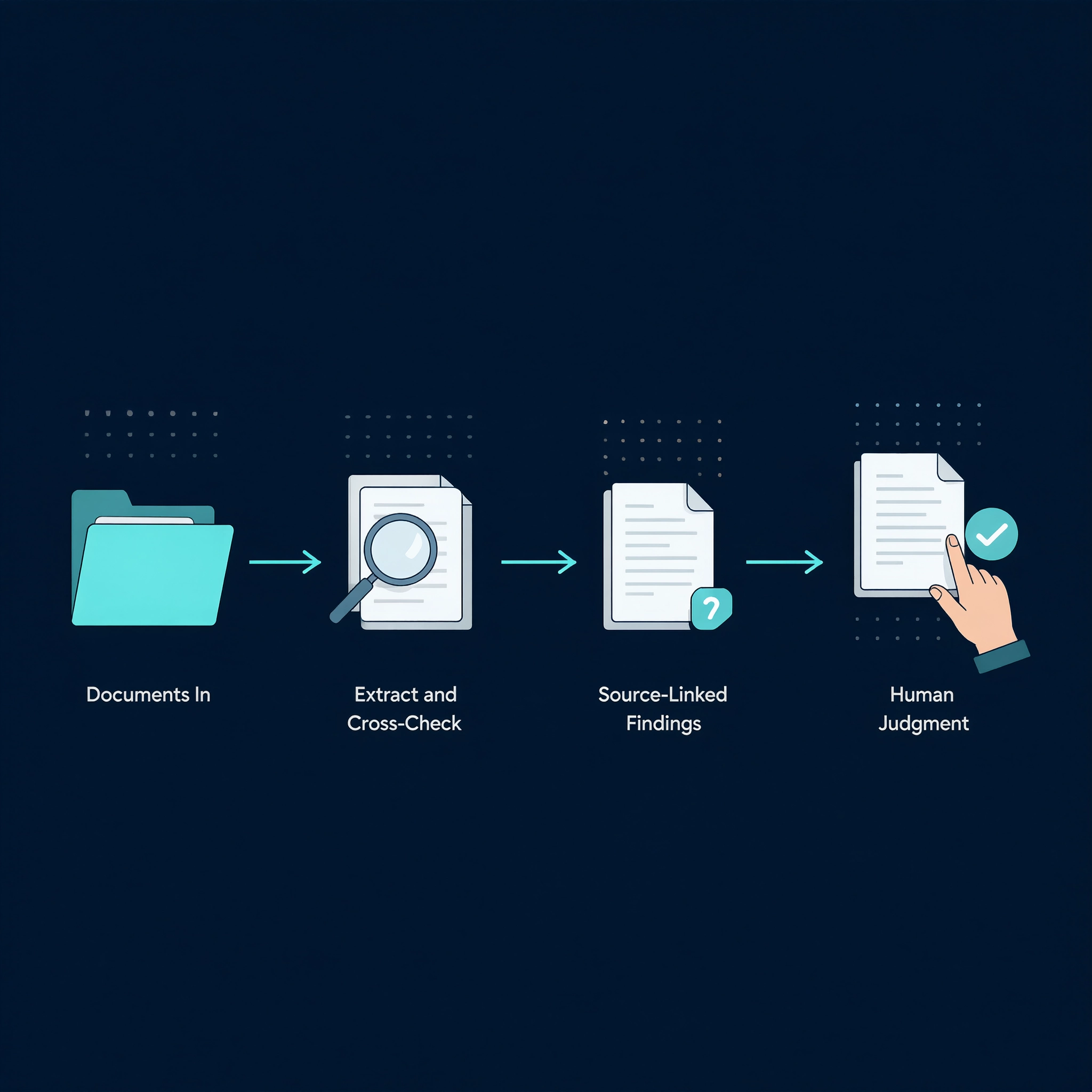
AI due diligence for private equity and M&A work starts where the documents are. A mature target can arrive with a populated data room: customer contracts, a shareholder agreement, a ledger with history, and named counterparties to check. Hebbia's roundup addresses deal teams working through large document sets, and Harvey's guide is written for M&A professionals. Both are vendor sources, and their positioning describes the use case they sell.
Compare the two ends of the range directly. A Series A company with a populated data room might have a dozen customer agreements, a signed shareholder agreement, twelve months of accounting history and a small set of named counterparties. Document review can read the whole set and link answers to pages; contract review can work from those agreements; financial analysis can work from the ledger; compliance screening can check the founders, the entity and the named counterparties. A pre-seed company that has sent a 12-page deck and has not opened a data room has supplied one document, with a founder call scheduled but not yet held. Whether contracts, accounting records or a counterparty list exist and were sent by another route is a separate question, and the absence of a data room establishes nothing about them. Ask, and the answer changes what each lane can read.
Financing stage does not by itself decide the tool list. What decides it is the evidence in front of you, the scope of the review and the risks you are underwriting. In the two examples above, the document populations differ because one company was described with a populated data room and the other with a single deck, not because every company at a given financing stage holds a set number of documents. Document count alone does not determine how much review work a lane needs: a small set of complex or unusual agreements can demand more specialist attention than a large set of routine ones, and the risk being underwritten sets the depth. A pre-seed company may already have a few signed contracts, basic accounting records and identifiable founders, so parts of these checks are possible in reduced form. Agreements always have counterparties, so the question at pre-seed is how many named counterparties exist to screen, not whether any exist.
The output of these platforms is an AI due diligence report tied to the documents submitted. A document that was never submitted cannot be examined, so silence about it is not a clean result, and the gap in coverage can itself be recorded as an evidence gap. No flag on what was read is not the same as no risk. A deck can still support source-linked answers: a finding can cite a specific deck page. What is unavailable at that point is cross-document comparison and the document populations the other lanes read.
What Can AI Check in an Investment Review?
At the category level, the work these tools are built for is concrete: reading and indexing a document set, extracting provisions from contracts, reviewing financial records for unusual entries, screening named entities against external lists, and drafting findings that point back to their source. Harvey's guide sets the standard this should meet: every extracted provision, every flagged risk and every generated summary needs to point back to a specific document and a specific clause. That is a requirement Harvey says outputs should satisfy, not proof that every actual output does, so ask for a demonstration on documents like yours. Hebbia's roundup makes a similar vendor claim for the category as a whole: AI solutions help deal teams review entire data rooms in hours instead of weeks. Treat that as a vendor statement about coverage and speed, not an independent measurement.
What AI does not decide is the investment question itself. Harvey states it plainly: the technology does not make judgment calls about whether a risk is acceptable or how it should affect the deal. Hebbia's own roundup says it does not replace judgment, and a human still decides what a flagged clause means for the deal. Neither position decides whether a market is reachable, whether a founding team can execute, whether a forecast is credible, or whether the price is right. Those are company-level judgments.
Two limits are worth keeping separate. The first is missing documents: no ledger means no ledger anomaly check, and no contract set means no clause extraction. The absence is itself an evidence gap worth recording, because it tells you what has not been examined rather than what has been cleared. The second is the reservation of final judgment to humans, which applies even when every document is present. A tool can read a complete data room and still leave risk acceptance, deal terms and the investment decision with the people responsible for them. Absent evidence and human judgment are different constraints. When a report is silent on a topic, that silence does not clear the risk; it tells you nothing either way until you check what was submitted and what was asked.
How Do Document Tools Compare With Company-Level Structured Analysis?
The two approaches are complements at different points in a review, not substitutes. One reads documents you already have; the other organizes what the company is and where its case is weak. The four workflow rows below follow the grouping in Hebbia's vendor roundup: M&A, legal, financial, and compliance. Each row also names the platforms this comparison covers: Hebbia and Datasite for document review, Kira, Harvey and Luminance for contract review, Keye and MindBridge for financial analysis, and ComplyAdvantage and LexisNexis for compliance screening. The vendor sources behind that roundup establish the four workflows and the count of ten; they do not establish which platform belongs in which row, and this article makes no capability or accuracy claim for any named platform. Treat each placement as a starting point to confirm with the vendor. The tasks listed in each row are illustrative of the workflow rather than verified capability statements for any platform.
Workflow | Minimum input | What the workflow covers | What it leaves open Document review (Hebbia, Datasite) | A document set; a single deck is enough for page-linked findings, while cross-document checks need more than one document | Reading across the submitted files and linking answers back to source pages | Whether the business itself is investable Contract review (Kira, Harvey, Luminance) | An agreement set | Extracting provisions and flagging unusual terms across agreements | Demand, pricing, team capacity, financing needs Financial analysis (Keye, MindBridge) | Ledgers and financial statements | Structured reading of the records, with unusual entries surfaced for a human look | Whether the forecast assumptions hold when history is thin Compliance and AML screening (ComplyAdvantage, LexisNexis) | Named founders, the target entity and any counterparties named in the materials | Checks against sanctions lists, watchlists and adverse media | Product, market and execution risk Company-level structured analysis | The company's materials plus current public context | Strengths, gaps and risks across fixed business dimensions such as market, team, financials and fundability, with confidence notes | Contract clauses, ledger anomalies and screening hits, which belong to the document workflows above, to manual review, or to specialist counsel and accounting work rather than to any single tool
A buyer with a populated Series A data room can run both layers: document workflows over the contracts, ledger and counterparty names, plus a company-level read of whether the case holds together. A buyer with a pre-seed deck mostly has the second layer available, and the first layer grows as documents appear. Which layer you need follows the evidence you hold and the risk in front of you, not the financing label on the round.
Worked Example: A Pre-Seed AI Startup With a 12-Page Deck
The following is a hypothetical example, not a real case. An angel investor is looking at a pre-seed AI startup. The company has sent a 12-page deck, a founder call is scheduled, and no data room has been opened. No contracts, accounting records or counterparty list have been supplied, and whether any of those exist is unknown until the founder is asked. Here is what each tool category could and could not answer from the documents actually in hand.
Document review: the deck itself can be read and findings can cite specific deck pages, so a source-linked answer is possible. What is unavailable is a cross-document consistency check, because no second document has been supplied to compare against. Contract review: no customer agreements, supplier terms or employment contracts have been supplied to extract from; if a small number exist, they can be requested and reviewed. Financial anomaly analysis: no ledger and no historical statements have been supplied, only a forward projection in the deck. Compliance screening: a check of founder and entity names against sanctions and watchlist sources is possible, but no counterparty population has been supplied to screen at scale.
What still has to be surfaced and verified at the company level: whether the market claim is reachable rather than merely large; whether the team has the capability the plan assumes, including roles not yet filled; whether the financials show a path where revenue grows faster than cost; and whether the round is fundable on current evidence, meaning the ask matches the milestones and the risks that could leave it short. Each of those findings needs its own evidence, its stated reason and an honest confidence note. Missing evidence lowers confidence and limits the depth of findings; it does not by itself prove a weakness, and a gap in the record is not a finding against the company. The investor's next step is to turn each gap into a question for the founder call and then check the answers against records the founder can produce.

Which AI Due Diligence Tools and AI Due Diligence Software Fit Your Review?
Tool selection follows the evidence in front of you, the scope of the review and the risk you are underwriting, rather than the financing stage alone. Start by listing what documents actually exist, what questions the review must answer, and which of those questions depend on documents versus judgment.
Then match the lane to the work: document review for whatever document set you hold, growing as the data room fills; contract review for an agreement set; financial analysis for ledgers and statements; compliance screening for named entities and counterparties. If your review is mostly a company case with thin documents, the document lanes contribute little until documents appear, and a company-level structured analysis carries more of the load. Also weigh deal volume, pricing model, and where the tool sits in your existing workflow. A tool that requires a step outside your data room and document systems adds friction to each review, and whether that friction affects how much your team uses it is something to assess against your own process. These are editorial selection considerations for your own evaluation, not criteria published by any vendor named in this article, and not measured adoption outcomes.
AI Due Diligence Checklist: Five Buyer Questions
An AI due diligence checklist for a buyer has five working questions. The first comes from the selection factor Hebbia publishes and the traceability standard Harvey sets out; the remaining four are editorial buyer questions to put to any vendor.
Auditability: does each output trace to its source in the form that source takes? A contract finding should point to a clause, a financial finding to a ledger entry or statement line, a screening finding to a watchlist record, and a claim drawn from a deck to a deck page. Not every finding concerns a contract clause, so ask what reference type each category of output carries. Request a demonstration on a document set like yours rather than a curated demo. Traceability is Hebbia's published selection factor and the standard Harvey says outputs should meet; as a buyer, treat it as your own requirement, because a finding you cannot trace is hard to defend in an investment memo.
Data retention and training: does the platform keep customer data, is that data used to train models, what certifications and client-isolation terms apply, and for how long are reports retained? Confirm current terms directly with the vendor, because policies change and a roundup's summary of one vendor's policy does not describe the market.
Integration: does the tool work inside the data room, document management and modeling systems your team already uses, or does it add a step?
Document coverage: does the tool read the full document population or a sample? Coverage scope changes what the report means. An exhaustive check, such as screening every named entity against a list, supports a statement about the whole population. A sampled or partial read does not, unless the sample is drawn and analyzed in a way that supports a properly qualified statistical inference, which you should ask the vendor to state explicitly. A sample-based answer presented as a whole-population answer cannot carry the weight of a memo.
Use-case fit: match the platform to the work in front of you, whether that is M&A document review, legal contract analysis, financial analysis or compliance screening, and to your deal volume and pricing model.
Two limits on the surrounding content are worth stating. Vendor roundups are marketing, so rankings and time-savings figures are vendor statements. And the search phrases this article is written around come from Google autocomplete, which reflects language patterns rather than measured demand; no search volume or impressions for these phrases were observed on our property.
What Is an AI Due Diligence Questionnaire?
An AI due diligence questionnaire is a request list: the questions a buyer sends a seller before or alongside access to the data room. It sets out what evidence the review depends on, from contract terms and financial records to ownership and compliance records. The sources available for this article do not establish that any platform drafts these lists or pre-populates answers from existing files, so treat questionnaire automation as a per-vendor question rather than a category capability, and verify any time-saving figure attached to that claim on your own document set.
Each answer still needs a source, and an unanswered item is an evidence gap rather than a negative finding. Treat the questionnaire as a coverage map for your review: it shows which documents to request first and which answers must be verified against records before they carry weight.
Which Due Diligence Tools Work for Early-Stage Investors?
For a pre-seed or seed investment, the document-oriented AI due diligence software lanes have thin input in specific places, so where the available evidence is mostly a deck and a founder conversation, the practical answer is a company-level structured analysis first, with document tools added as documents appear. A structured first pass organizes strengths, areas for development, risks and evidence gaps across fixed dimensions, attaches a confidence note to each reading, and produces follow-up questions tied to the gaps that matter. That gives the investor a defensible starting point for the founder conversation and a list of what to verify next: contracts when they exist, ledger detail when there is history, entity and counterparty screening when those names appear.
For a founder reviewing the company before approaching investors, the same logic runs in reverse. The report shows how the materials land from outside, which claims lack support, and which questions an external reviewer is likely to raise. Human verification then does the work the report cannot: checking figures against original records, testing market claims with customers, and confirming team and legal facts with specialists.
A DDScore report is supporting analytical material for that process. It organizes strengths, gaps and risks with evidence and confidence notes so you can see what to verify next. It is not an audit, an assurance certificate, a credit rating, proof that claims are true, investment advice, or a guarantee of financing or investment outcomes, and it does not make the investment or board decision. The decision stays with the people responsible for it.
Explore DDScore for Founders · Explore DDScore for Investors