

Preparing for a board meeting starts with a decision, not a deck. Build the pack around two or three decisions you actually need the board's help with, send it five to seven days ahead, and preview difficult news with each director beforehand. Meeting time should be spent on discussion, not presentation. A board that has read the material arrives with questions instead of spending the first twenty minutes discovering what the material says. The pack window and the framing principles below follow CRV's founder guide, one venture investor's published guidance rather than a universal standard, together with Crowell & Moring's US year-end client alert; your bylaws, investor agreements and local law govern what actually applies to you. The rest of this article works through the pack contents, the board meeting agenda, the year-end items, and a complete 90-minute example you can adapt.
Which Decisions Genuinely Need Board Input?
Start by listing every decision, problem and update competing for board time, then rank them by impact and urgency. This article applies a working rule of its own: pick the top two or three items where board input will actually change your decision or approach. That is the test for discussion items. If the answer would be the same with or without the room, it is an update, not an agenda item.
Three kinds of business sit on a board agenda, and they need different treatment. Strategic choices need discussion and often a recommendation from you. Formal approvals need a vote: budget adoption, equity grants, officer ratification, auditor appointment. Routine reporting needs nothing but acknowledgment. Mixing the three is what turns a meeting into a readout, because the routine material expands to fill whatever time it is given.
Required approvals are the exception to the update test. A budget adoption or an equity grant stays on the agenda even when you expect unanimous agreement, because the vote itself is the deliverable and the minutes have to record it. For everything else, use a useful filter before you write anything: for each candidate item, write the sentence you want the board to say at the end of it. If you cannot write that sentence, the item is not ready. If the sentence is "thanks for the update," move it to written material. If the sentence is "we agree with your recommendation" or "choose option B," it belongs in the room.
A consent agenda handles the routine layer. BoardSource describes it as a section of the agenda that groups routine, non-controversial items into a single package for one combined vote, with any director able to request that a specific item be removed and considered separately. The point is to reclaim discussion time, not to bury anything: the block is for items that need no deliberation, and anything that needs argument stays on the agenda in its own right.
What Goes Into the Startup Board Pack and What Belongs in the Appendix?
A board pack is the complete set of documents a startup CEO sends to directors before a meeting. For an early-stage company, the core is short and the appendix is where depth lives. Keep the core deck focused on the strategic decisions in front of the room, and put detailed operational metrics and supporting documents in an appendix for reference.
The recurring baseline, present at every meeting, is small: the previous meeting's minutes; financial statements covering profit and loss, balance sheet and cash flow; a key metrics dashboard; and a progress update on commitments from the last meeting. For the dashboard, this article suggests six to eight indicators as a starting point. An illustrative set might cover revenue, burn rate, runway, customer acquisition and retention. Both the count and that list are this article's suggestion, not a standard set from any source cited here. The commitments item matters more than it might seem. Directors notice when a promise made six weeks ago disappears from the material without explanation, and addressing a missed commitment directly costs one paragraph, while avoiding it costs credibility.
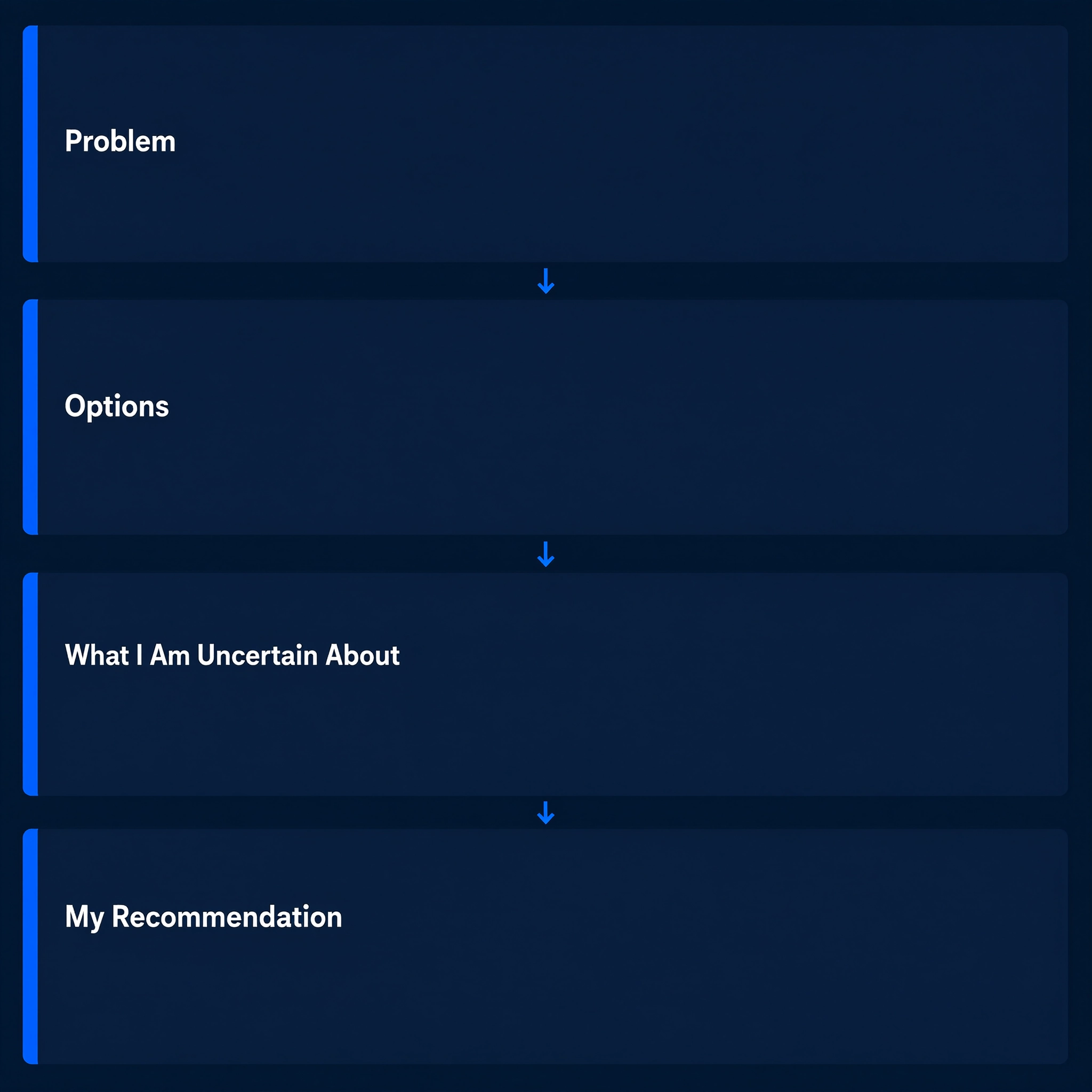
On top of the baseline, each decision on the agenda gets its own one-page summary: the problem, the options you are considering, what you are uncertain about, and your recommendation. Supporting evidence follows, such as customer feedback, financial projections or competitive context that informs that specific choice.
The appendix rule is simple. If a director might ask for it, include it, and do not make it part of the core narrative. Detailed cohorts, the full cap table, departmental spreadsheets, prior minutes beyond the last meeting and contract drafts belong there. A pack that tries to prove how much work has been done buries the three decisions that matter, and directors serving on several boards stop reading past the point where the signal gets thin.
When and How Should Board Materials Circulate?
Before you fix any date, check your own documents. Notice periods, distribution requirements and any budget or compensation deadlines can be set by bylaws, investor rights agreements or local law, and those override any general guidance in this article.
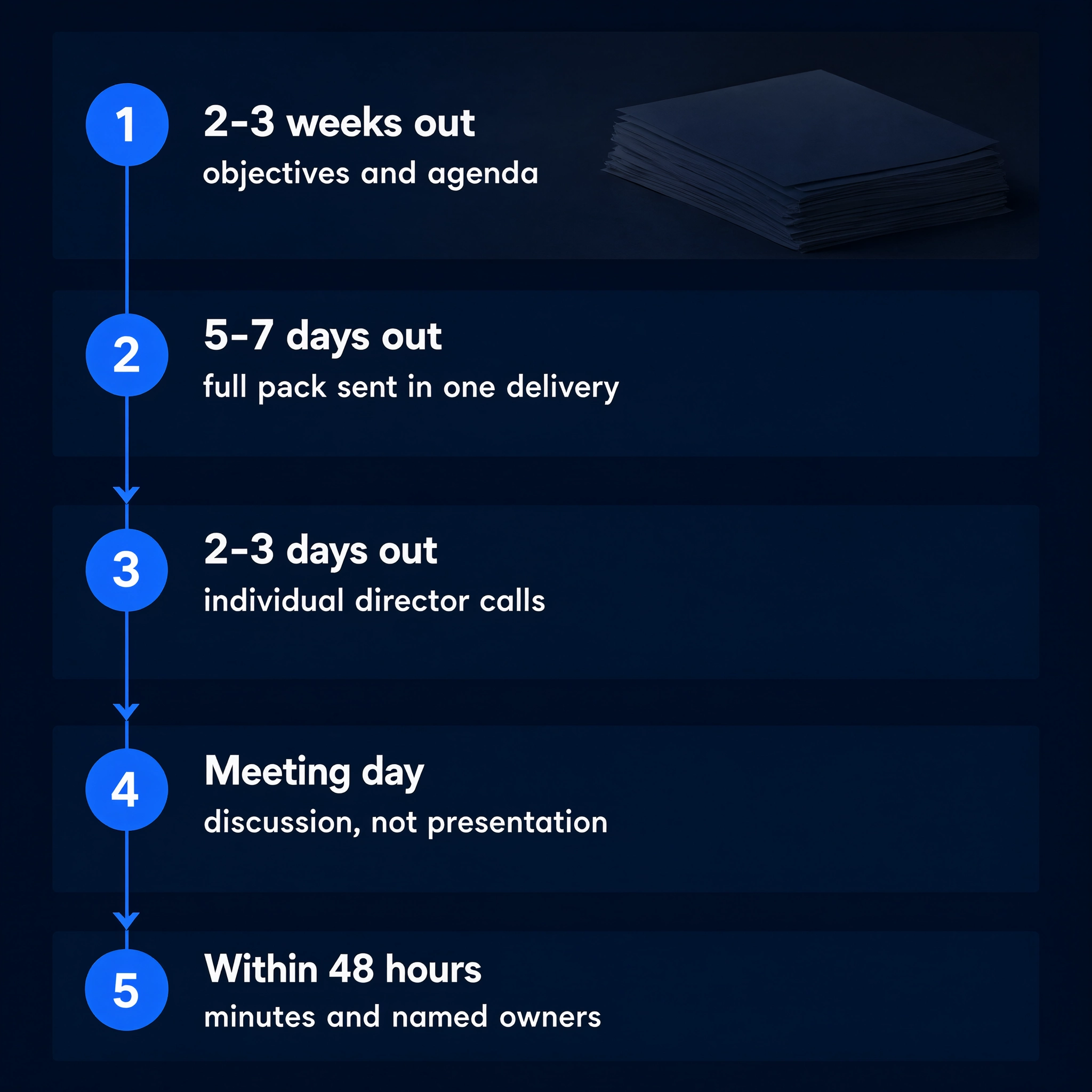
With that settled, send the complete pack in one delivery, five to seven days before the meeting. That window is CRV's published recommendation to founders. The wider calendar used in this article is the article's own working schedule rather than CRV's stated timeline: set the objectives and the agenda two to three weeks out, make individual calls to each director two to three days before, and send minutes within 48 hours after. Only the five-to-seven-day pack window and the 48-hour minutes rule come from CRV. BoardSource gives a separate recommendation about a different document: distribute the meeting agenda at least one week before the meeting. One concerns the agenda, the other the full pack. Put both on your calendar as separate checkpoints rather than merging them into a single rule. Diligent's board pack guide, dated July 9, 2026, states a typical pack window of seven to ten days, and ten to fourteen days for complex or high-stakes meetings. These are separate published recommendations from different publishers about different materials, so treat them as reference points rather than one universal rule.
Distribution style matters as much as timing. Send the agenda, financials, metrics and decision material together in one email or shared folder rather than trickling them out over several days, because a pack that arrives in pieces gets read in pieces. Then call each director two to three days before the meeting to check whether anything in the material needs clarification. Those calls move basic questions out of meeting time.
Bad news follows a longer clock. CRV advises letting directors know about significant issues seven to ten days before the meeting so the problem is not delivered for the first time in the room, and its underlying point is that investors want to know about problems as soon as you do, so they can help solve them. The seven-to-ten-day window is the latest practical point before the meeting, not a reason to hold back a newly identified issue until it fits the schedule. Crowell & Moring's year-end guide makes the same point for tough topics such as missed targets, team changes or fundraising challenges: call each director individually ahead of time to preview them. Previewing is not spin. It means the discussion starts at the substance instead of at the surprise.
How Do You Frame One Decision So Directors Can Prepare?
Write agenda items as decisions with named options, not as topics. CRV's guide makes the case for the specific version of an item: it tells directors what you need from them, which is a decision; it gives them the tradeoff to prepare for; and it focuses discussion time on helping you think through the choice rather than on explaining what the choice is. This article puts that into practice by writing each line as a decision with named alternatives. In this example, invented here rather than taken from CRV and not based on a real company, the vague line "discuss the Q2 hiring plan" becomes "approve three engineers in Q2 versus two engineers and one product manager." The specific version names the tradeoff, so a director arrives with a view instead of an open question about what is being asked.
The one-page decision brief that sits behind that agenda line has four parts. Problem: what is being decided and why it cannot wait. Options: the realistic alternatives, including doing nothing, with the cost of each. Uncertainty: the assumptions you are least sure of and the evidence that would settle them. Recommendation: what you lean toward and why. Also state explicitly on the brief whether you are asking for the board's consultation or for its formal approval. Without that line, a director may treat a vote as a discussion, or a discussion as a vote.
Here is a second hypothetical example, again not based on a real company. Vague agenda line: "Discuss enterprise pricing." Decision line: "Decide whether to introduce three-tier enterprise pricing for the two pilot accounts or hold current pricing until the next renewal cycle." The brief then carries the two options, the uncertainty about implementation effort, and your recommendation. A director who reads that in advance arrives with a view on implementation cost rather than spending discussion time on what the terms mean.
Diligent's agenda guidance captures the discipline in one sentence: pair each item with a time allocation, an owner and an outcome of decide, discuss or inform. Writing the outcome next to the item is a small change with an outsized effect on how the meeting actually runs.
How to Run a Board Meeting for a Startup Without a Status Readout
Open with a tight update and then go straight to the decisions. CRV's guidance is to limit updates to 15 to 20 minutes, with the rest of the meeting for strategic discussion on your top items. The sample agendas below apply that cap to a 90-minute meeting; the 90-minute length is this article's choice for the examples, not a figure from CRV. NFX's guidance makes a different recommendation, expressed as a ratio: spend 30 percent of the meeting on updates and 70 percent on the forks in the road, operational challenges and strategy. These are not two versions of one rule. Thirty percent of a 90-minute meeting is 27 minutes, well above CRV's cap, so pick the guidance that fits your meeting length instead of blending them.
During the discussion blocks, your job is to manage time and elicit the expertise in the room. Park anything that runs long and take it outside the meeting. Finta's agenda guidance states the tradeoff plainly: if the discussion needs more time, reduce reporting rather than rushing the important question. A meeting that ends on time with one decision properly examined beats a meeting that covered nine topics and settled none.
Close with next steps before anyone leaves. Document what was decided, assign each action to a specific person by name with a deadline, and schedule the next meeting while everyone is still on the call. CRV's follow-up rule is minutes within 48 hours, stating what was decided, who owns each action item and when it is due. Named owners, not job titles, because "the VP of sales will handle it" is how commitments evaporate.
Leave room at the end for an executive session without management present. The American Bar Association's November 26, 2025 governance guidance describes a protocol for this: the CEO is invited in for a portion of the session to exchange candid feedback, then excused so the board can discuss independently. Whether your board holds one, when it happens and who attends are governed by your governing documents and your board's composition. If yours has not done it before, raise it as a process improvement rather than waiting for a sensitive topic to force it.
Five preparation failures run through this article: materials sent too late, an agenda overloaded with operational detail, missing follow-up, vague objectives, and being cagey about challenges. This list is the article's own summary of the patterns it describes, not a checklist quoted from a single publisher. Each one is a preparation failure that shows up as a meeting failure.
What Is Specific to the Year-End Board Meeting?
The year-end meeting often carries governance items that a quarterly session may not. Crowell & Moring's November 3, 2025 client alert covers the US year-end process. Note the scope: that is a US law firm describing US practice, so jurisdiction, your charter and your investor rights agreements govern what actually applies to you.
The budget comes first in time. Crowell states that most venture-backed companies are required under their investor rights agreements to present a budget at least 30 days before year-end. This article would then use the meeting to review performance against the past year and set goals for the next twelve months across headcount, product milestones, revenue assumptions and fundraising. Treat the budget as a plan you can revise when conditions change rather than a document that cannot move.
Then compensation and equity. What your board actually reviews, such as past bonuses against performance or predefined goals, next year's bonus plan and its metrics, or salary adjustments, depends on your compensation arrangements and your governing documents. Where equity grants are in scope, Crowell advises completing a 409A valuation in advance to establish fair market value before awards are issued.
Administrative items typically come next: appointing or reappointing auditors, ratifying corporate officers, adopting or updating compensation guidelines, and forming or confirming committees where your documents provide for them. Which of them apply to you, and whether any of them can sit in the pack as a consent block instead of consuming discussion time, depend on your charter, your agreements and whether a director wants a particular item discussed. Anything that needs deliberation stays off the block.
Two process points deserve their own line. First, privilege: where sensitive legal matters come up, take your counsel's guidance on who should be present and how the discussion is documented. That is a legal judgment, not a meeting-format question. Where a director has a conflict, follow whatever committee, recusal or approval process your documents require. Second, preview: Crowell's advice for a tough topic such as missed targets, team changes or fundraising challenges is to call each director individually ahead of time, exactly as in a regular meeting.
How Do You Use an Outside Analysis in the Room Without Outsourcing the Decision?
A structured outside analysis can feed the pack with strengths, risks and open questions that directors can challenge one at a time. DDScore produces that kind of material: scores and written reasoning across twelve dimensions, strengths, risks, evidence limitations, and follow-up questions tied to specific findings. Missing material does not stop the analysis, but it can lower confidence and limit the depth of findings, and the report says where that happened. Placed in the appendix or attached to a decision brief, it gives every director the same starting picture before the discussion begins. If the board wants to work through scenarios on top of that material, that work happens in the room: the report supplies the findings and the reasoning, and the directors supply the scenario analysis and the conclusion. The report reading guide explains how to read the scores, confidence figures and evidence gaps.
The boundary matters. Such a report is supporting analytical material for discussion. It is not a board decision, not an audit or assurance opinion, and not a guarantee of any outcome. Directors should argue with it: which findings rest on evidence you supplied, which rest on public sources, which are missing evidence rather than adverse evidence, and which assumptions would change the conclusion if they moved.
Used well, it changes the shape of the conversation. Instead of the first fifteen minutes establishing what the materials say, the meeting starts at the disagreement. Used poorly, it becomes an authority the room hides behind, which is exactly the failure this article is trying to avoid. The decision stays with the board and the responsibility for it stays with the people in the room.
A Sample 90-Minute Board Meeting Agenda
This is a worked example built on a decision-first structure, not a governance requirement. Adjust it to your bylaws, your board's composition and the decisions you actually face. Both schedules below show where required business sits. Approval of the previous minutes, and any routine item that needs a vote but invites no argument, go into a short consent block right after the opening updates, with any director able to ask that an item be handled separately. An approval that needs real deliberation, such as a budget adoption or an equity grant, is not a routine item: it counts as one of the decision slots, and if that makes it a fourth item you rebuild the schedule rather than squeezing it in.
0:00 to 0:12 Opening updates. Top three wins, top three challenges, key metrics snapshot. Nothing that requires a decision. Twelve minutes, inside the 15-to-20-minute cap.
0:12 to 0:18 Consent block. Approval of the previous minutes, plus routine items needing a vote such as ratifications your documents require, one combined vote unless a director asks to separate an item.
0:18 to 0:42 Decision one. Two minutes of framing from you, then discussion. Your recommendation stated first so the room argues against a position rather than around one.
0:42 to 1:06 Decision two. Same structure.
1:06 to 1:16 Next steps. Decisions recorded, action items assigned to named owners with dates, next meeting confirmed.
1:16 to 1:26 Executive session, without management present, if your board holds one.
1:26 to 1:30 Buffer and parking lot review: anything parked gets an owner and a date or it is dropped.
If a third decision is genuinely needed, rebuild the whole schedule instead of squeezing it into the one above. A complete 90-minute version with three decisions:
0:00 to 0:10 Opening updates. Ten minutes only: top three wins, top three challenges, key metrics snapshot.
0:10 to 0:16 Consent block. Approval of the previous minutes and routine items needing a vote, one combined vote.
0:16 to 0:36 Decision one. Two minutes of framing, then discussion, recommendation stated first.
0:36 to 0:56 Decision two. Same structure.
0:56 to 1:11 Decision three. Fifteen minutes, framed in one minute.
1:11 to 1:19 Next steps. Decisions recorded, named owners with dates, next meeting confirmed.
1:19 to 1:26 Executive session, without management present, if your board holds one.
1:26 to 1:30 Buffer and parking lot review.
A fourth discussion item goes to written material or to the next meeting. Required business is not a discussion item and is not subject to that limit: a vote your documents require stays on the agenda, either inside the consent block when it needs no deliberation or as a decision slot when it does, and then you rebuild the schedule rather than squeezing it in. If discussion overruns, reduce reporting. Do not cut the next-steps block, because that is the part that makes the following meeting easier to prepare for.
One-Page Decision Brief Template
Use one page per decision. The four headings below are the whole template; the hypothetical hiring example above, invented for this article, shows the level of specificity to aim for.
Problem: what is being decided, why it matters now, and what happens if it is deferred.
Options: the realistic alternatives, including doing nothing, with the cost, risk and resource requirement of each.
What I am uncertain about: the assumptions you least trust, and the evidence that would resolve them.
My recommendation: what you lean toward, why, and whether you are asking for the board's consultation or for its formal approval.
Attach the two or three data points that inform the choice, and leave everything else in the appendix. A brief that runs past one page has started to become a status report.
Board Meeting Preparation Checklist
Before you schedule anything: check your bylaws, investor agreements and any applicable law for notice periods, distribution requirements, and budget or compensation deadlines. Fix the meeting date and the distribution window only after that.
Two to three weeks before: list every candidate item, rank by impact and urgency, select two or three decisions, and write each agenda line as a decision with named options. Confirm the meeting date and quorum. This is this article's working schedule.
Seven to ten days before, if there is difficult news: preview it with each director individually, before the pack goes out. This is the latest practical point, not a reason to wait. Tell directors about a significant issue as soon as you know about it, because the point of the preview is that they can help solve the problem rather than meet it for the first time in the room.
At least one week before the meeting: send the agenda on its own. BoardSource recommends distributing the meeting agenda at least one week before the meeting. This is a separate checkpoint from the full pack, so keep it on the calendar as its own step rather than folding it into the pack delivery below.
Five to seven days before: assemble and send the complete pack in one delivery, agenda included again so directors have one complete set in front of them. Core: agenda, previous minutes, financial statements (profit and loss, balance sheet, cash flow), metrics dashboard, progress on previous commitments, and a one-page brief per decision. Appendix: detailed metrics, cap table, contracts, prior documents.
Two to three days before: call each director to check for questions on the material. Test video and room setup, confirm time zones and links, and run through handoffs with anyone else presenting.
Day of meeting: open with updates capped at 15 to 20 minutes, approve the previous minutes and any routine consent items, work the decisions, close with named owners and deadlines, hold an executive session only if your board uses one, and confirm the next date.
Within 48 hours: send minutes stating what was decided, who owns each action item and when it is due. Carry unresolved items into the next agenda rather than letting them lapse.
Before the next cycle: note what slowed the meeting down, such as late material, an overlong update or a decision deferred, and adjust the checklist and time boxes. They are reusable starting points rather than something to rebuild from scratch each quarter.
Sources
- CRV | How to Prepare for Board Meetings: Founder Guide
- The Founder's Guide to Effective Year-End Board Meetings
- How To Run An Early-Stage Board Meeting
- Startup Board Meeting Agenda: A Practical Template
- Effective Board Meetings - Best Practices
- Board agenda: Complete guide with free templates
- Board meeting preparation checklist: what you need
- What Is a Board Pack? A Startup CEO's Guide + Free ...
- Seed-Stage Board Meetings: Best Practices for Founders
- Consent Agenda: What It Is and How to Use One
- Early-Stage Venture Capital
- 10 Tips for Executive Sessions: The Year in Governance
Explore DDScore for Founders · Explore DDScore for Investors