

An AI due diligence report is validated by tracing every material claim in the summary back to the source document and named evidence, sampling a predefined share of the remaining cleared items, and having a named human sign off on anything that would change the decision. Treat the summary as an index of where to look, not a finding of record. Your team already has the hard part done: the documents are read and a draft summary exists. What follows is a validation protocol for output that has already been produced, with a worked example, a sign-off rule and a clear view of what each review method can and cannot establish. Our earlier AI due diligence article explains tool categories and document-coverage limits; this article covers the check on the output itself.
What the AI Summary Is Actually Doing When It Reads a Document Set
A diligence summary is not a second reading of the deal. One useful way to picture the machine process behind it has four stages: ingestion of the file set, extraction of clauses, figures and defined terms, benchmarking against whatever criteria were configured, and reporting into a structured draft. Treat that as an explanatory model for reasoning about the output, not as a description of how every product on the market is built. Systems differ in how they split the work, and the useful question for your team is not whether a tool matches this diagram but how the specific tool in front of you handles each step. Each stage can fail quietly, and each failure can show up later as a sentence that reads confidently and cannot be defended.
Coverage is the first thing to check, before any sentence. One failure mode worth looking for is a document that fails to parse and produces no findings rather than an error anyone notices, which would put the gap between the loaded count and the parsed count exactly where coverage is lost. How a specific tool handles image-only PDFs, photographed signature pages, handwritten amendments, password-protected files and spreadsheets holding commercial terms is a configuration question you have to verify for your own platform: some setups convert, some skip, some extract partial text, and you should not assume which applies. Check whether the tool surfaces a scanned or unreadable document as a gap or simply stays silent about it. Hypothetically, if 1,000 files were listed in the data room and 800 parsed, the summary can only draw on those 800 parsed files, and whether anyone sees the difference depends on whether the counts are reported side by side. Parsing establishes that the tool read a file. It does not establish that every parsed file contributed to the summary, or that a reviewer checked it.
This is why the ingestion report matters as much as the risk report when you choose a due diligence AI platform. Ask three questions of any tool output: first, the file-status question, meaning which files were listed, which of those were loaded, and which of those parsed; second, which criteria were applied to which file; third, where each finding points back to. Check what reference the tool records for a finding: a page, clause or cell reference, or nothing at all. A finding with no recorded reference is still checkable, because a reviewer can locate the supporting passage independently, but the locating work then falls on the reviewer, who has to find it before checking it. That is slower, easier to skip when the timetable compresses, and harder to retrace later unless someone records where they looked. A system that reports conclusions without provenance raises the cost of the second review rather than making it impossible, and the cost is paid by whoever signs off.
Which Errors Change the Decision?
Not every flaw in a summary carries the same weight. Sort errors into three classes, because each class needs a different response.
Class one is contradiction: the summary says something the source does not say. This includes a figure lifted from the wrong table, a period mismatch, a defined term read without its definition, and a claim that has already been changed by an amendment or side letter. Class two is definitional drift: the summary uses a familiar label such as retention, ARR or backlog while the underlying chart measures something narrower. The words are accurate and the meaning is not. Class three is silent non-coverage: the summary is clean because the file was never read, or because the category was never in the configured criteria. A system that silently excludes part of a data room produces a clean report on the part it could read, and the report alone will not reveal the difference.
Evalyze.ai's guide (May 17, 2026) lists what it calls the most common deal-killing red flags: cap table inconsistencies, unassigned IP from contractors, customer references that contradict the pitch, founder background discrepancies, undisclosed litigation, and aggressive financial projections without supporting data. That is one vendor's characterization of a list, not a measured frequency ranking, and the supplied material gives no counts behind it. The list is still useful for sorting, because it mixes two different problems. Some entries are contradictions between two documents or between a document and the outside world: a customer reference that conflicts with the pitch, or a cap table that disagrees with the board consents. Others are absences, and an absence in the data room is not the same observation as a contradiction. A summary can surface a contradiction when both pieces of evidence sit inside the room. It can also surface that an expected document is missing from the room, if the configured criteria ask for one, such as a missing IP assignment agreement. What neither observation establishes is the underlying fact: that contractor IP is in fact unassigned, or that litigation exists and was not disclosed. Those require checks outside the data room, such as counsel review or public records. Treat a missing-document flag as a question to answer, not as a finding to report.
Prioritize by decision impact rather than by severity label. Anything that would change price, structure, closing conditions, or the recommendation to proceed belongs in the trace-everything tier. Wording issues in a section that no one will read for the decision belong in the sample tier.
How Do You Validate AI-Generated Diligence Summaries So the Deal Team Can Rely on Them?
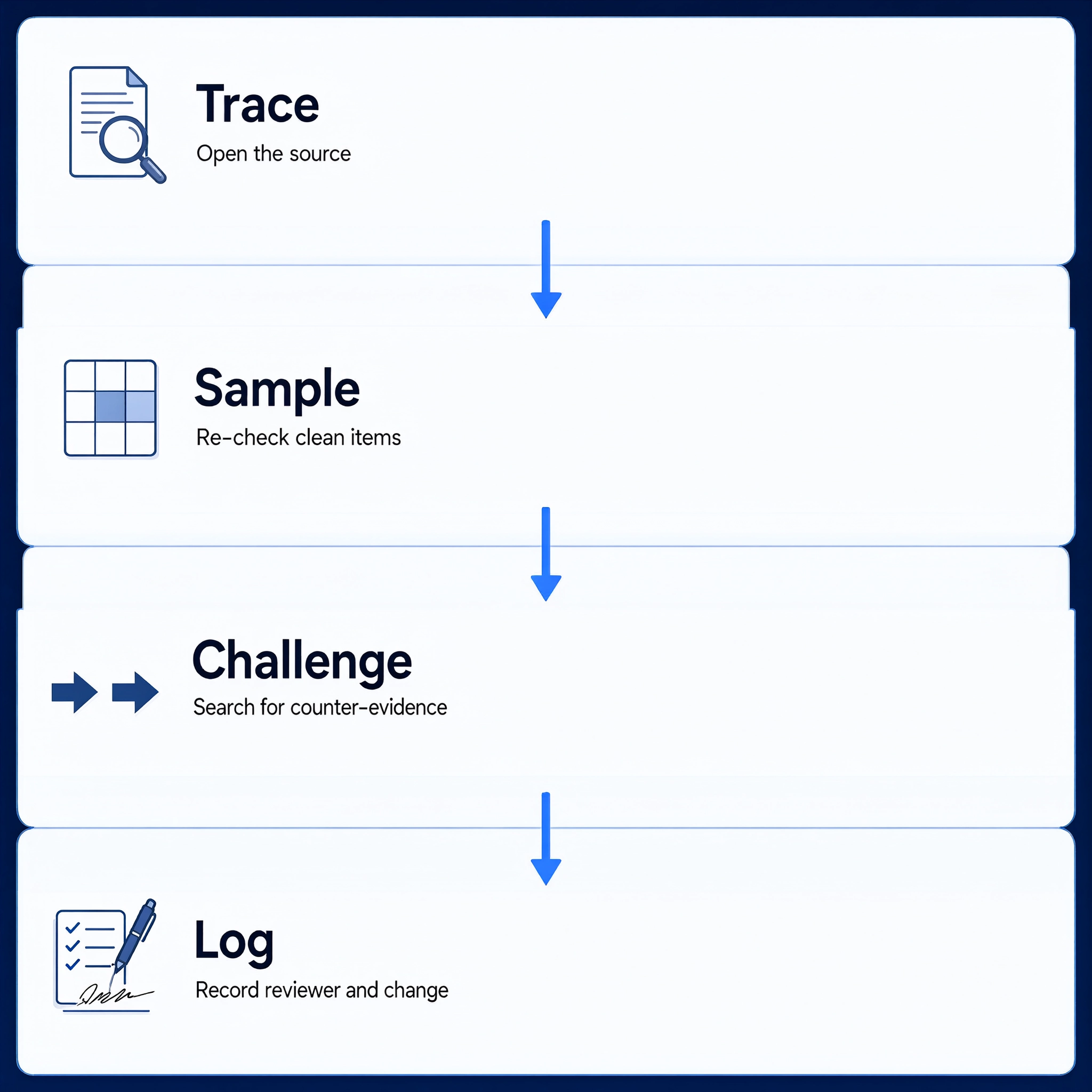
You validate them with four repeatable steps: trace, sample, challenge and log. This is the AI diligence review protocol, and it works the same way whether the summary came from a general assistant or from a purpose-built system. Before the four steps, one human judgment comes first: the reviewer sorts the summary's items by decision impact, because the protocol needs to know which claims are material. The system's own flags are an input to that sort, not a substitute for it, and a system clearance never moves a material claim out of the trace tier.
Trace. Open the source document rather than working from the extract. Read the clause or the chart in full, including the provisos that follow it. Check every defined term the clause depends on. Confirm that no amendment or side letter has changed the underlying term. Do this for every material claim, meaning every claim that would change a decision if it were wrong, including material claims the summary marked as clean. A clean status from the system does not move a material claim out of this tier.
Sample. Re-check a predefined share of the cleared items the materiality sort classified as non-material and did not send to the trace tier. Material claims are traced regardless of status, so the sample never substitutes for tracing them; it exists for everything else. Errors in cleared items do not appear in the queue at all, which is what makes them expensive. A reviewer who only verifies escalated items verifies the system's judgment about what matters and never tests that judgment. Set the rule in advance—for example, a random slice of cleared items outside the material tier plus every cleared item that falls within the two dimensions the committee will argue about and was not already traced as material—and record the rule before the review starts so the sample cannot be chosen after the results are known.
Challenge. Take each surviving claim and look for the document that would contradict it: the customer list against the revenue breakdown, the cap table against the board consents, the pitch against the reference notes, the forecast against trailing results. Where the summary relies on public information, check the date and the source of that information rather than the sentence that cites it.
Log. Record who checked what, when, what changed, and what remains open, for traced claims and sampled claims alike. The log is what turns a validated summary into something a second reviewer, a committee or a client can audit. An unlogged check is indistinguishable from no check.
Worked Example: Retention Strong at 95%
The following is a hypothetical line, labeled as such, showing how the four steps apply to one sentence. Three things do different work here, and the example keeps them apart: a human materiality assessment decides which tier an item enters, every material claim is then traced at source regardless of the status the system assigned, and the sample checks the cleared items that sit outside the material tier.
Hypothetical summary line: "Retention strong at 95%."
Materiality first. Before any file is opened, the reviewer sorts the item. Retention sits in Financials and feeds the forecast the committee will price against, so it lands in the trace tier. That classification is made by the reviewer, not by the system, and it is made regardless of the status the system assigned. A clean status changes nothing about a material claim: material claims are traced at source whether the system escalated them or cleared them.
Trace. Open the source. The chart is titled "Logo retention by quarter for the two newest cohorts" and covers two quarters. The 95% is real, and it measures logos retained—accounts rather than revenue—over a shorter period than the committee will assume from the sentence.
Sample. This line was traced because a reviewer judged it material, not because the system escalated it, and the sample is a separate check rather than an alternative to that tracing. The sample covers cleared items outside the material tier: items the materiality sort classified as non-material and that no one opened at source, where the system's judgment about what counts as clean goes untested. In this hypothetical the rule recorded before the review is a random slice of cleared non-material items plus every cleared item in the two dimensions the committee will argue about. One randomly selected line reads "Churn contained at 2% monthly" in a section nobody classified as decision-changing. It enters review only because the rule was set in advance; neither the system's flag nor the reviewer's intuition on the day would have surfaced it. Opening the source shows a chart of gross monthly logo churn for the largest customer segment over four months. Corrected wording: "Gross monthly logo churn was 2% for the largest customer segment over the four months shown (source: churn chart, page 14). No company-wide monthly churn figure appears in the data room." The sample therefore does what the trace tier does not: it tests non-material cleared items that the materiality sort classified but did not send for a source check. The log is not unique to sampling. Traced claims are recorded the same way, with reviewer, date, original wording, corrected wording and open items.
Challenge. Search the data room for twelve-month revenue retention. It is not there. The forecast in the model implies net revenue retention above 100%, which nothing in the room supports.
Corrected wording: "Logo retention is 95% over two quarters for the two newest cohorts (source: cohort chart, page 12). Twelve-month gross revenue retention is not present in the data room, and the forecast's implied net revenue retention above 100% is unsupported by any document in the room."
The two measures are different, so the definitions matter before the questions are written. Gross revenue retention counts only churn and contraction, excludes expansion, and is capped at 100% by definition. Net revenue retention adds expansion revenue from the same customers and can therefore exceed 100% (ChartMogul, published September 8, 2026; Stripe, published May 7, 2026). An answer to one question does not close the other.
Follow-up questions for the founder, kept separate for that reason: "What is twelve-month gross revenue retention by cohort, produced from the billing system rather than the deck?" and "What is twelve-month net revenue retention by cohort, with the expansion and contraction components shown, also from the billing system?" Each question states the measure, the period, the cohorts and the source system, because a figure produced to a different definition does not close the point. The forecast assumption stays open until the company produces the measure the forecast actually relies on, and the memo carries it as an open item rather than treating an answer to the first question as closing the second.
Log entry: reviewer, date, original wording, corrected wording, both open questions, owner and date for each.
The value of the exercise is not the corrected sentence. It is that the committee now sees a gap instead of a reassurance, and the gap has an owner.
Who Signs Off and Where Is That Recorded?
Diligence summary validation needs a named person, not a team. Name one reviewer who owns every material claim in the summary, including material claims the summary marked as clean: the word material does the work, because anything that could change price, structure, closing conditions or the recommendation is traced at source by that reviewer whether the system escalated it or cleared it. Name a second reviewer who spot-checks a defined share of the remaining cleared items, meaning the non-material items the first reviewer did not open. The second check exists because those are the items where the system's own judgment about what counts as clean goes untested. A shared queue with no single named owner is harder to keep current, because responsibility stays diffuse until someone claims the item. Workflow documentation for review queues describes the mechanism plainly: everyone in the queue receives a notification, but only one person takes ownership of a task, and a member must take ownership to complete it (Diligent, published November 6, 2026). The supplied material contains no completion-rate study of review queues, so this is a design rationale for naming owners rather than a measured effect on review quality.
Sign-off is a statement with scope, not a verdict on the deal, and it should record who performed each activity rather than collapsing them into one voice. The first reviewer's line: "I traced every material claim listed in the sign-off table to its source document on this date." The second reviewer's line: "On this date, I spot-checked the cleared non-material items selected by the sampling rule recorded before the review." The overall sign-off, held by whoever owns the summary for the committee, then states the condition of the whole review rather than claiming the checks personally: "Items 4, 7 and 12 remain open and are marked as such. The ingestion report shows 800 of the 1,000 files listed in the data room as parsed; claims drawn from the remaining 200 files, and any category outside the configured criteria, were not reviewed." The record therefore names four separate things: which claims were traced and by whom, which claims were sampled and by whom, what remains open, and what was excluded. The file counts describe the ingestion universe, not the verification. Parsing establishes that the tool read a file; it does not establish that the tool analyzed it fully or that a reviewer checked it. A sign-off that says "the data room" claims coverage of everything, including files the tool never read, so name the parsed count and the excluded categories alongside the claims actually checked.
Open items need a rule, because a sign-off that quietly permits them is where validation fails. If an unresolved item could change the decision, the sign-off is conditional by rule: the item is escalated to a named owner with a date, and the condition appears on the face of the memo. The committee can still proceed, but it proceeds knowing the condition exists. An unresolved item that could change the decision and is not named in the sign-off is a failed validation, whatever else the table says. An unresolved item that could not change the decision can remain in the log without conditioning the sign-off, provided someone has recorded why it is immaterial.
Where the record lives depends on your process. Affinity's guide (updated April 3, 2026) describes one venture workflow in which the deal team's findings are summarized in a deal qualification memorandum, and only when that memorandum is complete does the firm begin discussing deal terms with the company. The supplied excerpt establishes that memorandum stage and its relationship to discussing terms, and nothing before it; this article does not treat the memorandum as a placement rule for other organizations. The question it raises for your team is where verification status will live in your own process: a qualification memorandum, a diligence log, a memo appendix or a review record, in whatever document your organization already files and can retrieve later. If no such document exists, name one, because a sign-off nobody can find later cannot be checked by a second reviewer or a client.
Legal practice guidance sets a similar floor in plainer terms. Harvey's guidance on red-flag reports states that a qualified lawyer must review and confirm every flag before anyone relies on it, and that AI output should be treated as a draft to check, with the reviewing lawyer responsible for the final report. That is guidance for legal work specifically; your deal team's equivalent is the named reviewer and the conditional sign-off rule above.
How Validated Output Becomes a Memo the Committee Can Use
Committees differ in what they read, and no supplied source establishes a single committee format. The practical requirement is a document that argues a position and shows its work; in many processes that document is a memo. Convert the validated output into one in five moves.
First, state the scope: which documents were listed, which were loaded and parsed, which criteria ran, and which categories were never configured. Second, list the findings that survived validation, each with its source, its verification status and its severity. Third, list the open questions with an owner and a date, because an unanswered question without an owner disappears. Fourth, separate what the documents establish from what they merely assert. Fifth, connect each finding to a decision consequence: price, structure, condition, further work, or no action.
The standard to write toward comes from DFI Solutions' guidance on creating a due diligence report: the strongest reports do more than organize information. They interpret findings, explain implications, and provide context around potential outcomes. Hebbia markets AI platforms as automating the creation of standardized, defensible deliverables in a fraction of the usual time; that is a vendor claim about its own category, and the defensibility of your memo will come from the validation trail behind it rather than from the automation. An AI-generated draft can supply raw material for the memo. The interpretation layer is where the human work sits.
Keep the AI draft and the final memo as two visible artifacts. When a committee member challenges a line, you want to be able to show the original summary wording, the source page, the correction and the reviewer, in that order.
Three-Way Comparison: AI Summary, Analyst Spot-Check, Structured Company Analysis
The comparison below is an analytical guide for choosing where to spend review effort, not independent performance evidence. The supplied material contains no measured accuracy rates for any of these approaches, and what each one delivers depends on the specific tool, its configuration and the coverage you have verified. Read each entry across the same three columns: input, what it flags well, and what it cannot establish.
| Approach | Input | What it flags well | What it cannot establish | |---|---|---|---| | AI summary over a data room | A machine pass over the loaded file set, where the tool and configuration support it. | Volume work: cross-document mismatches, unusual clauses and missing items across a large file set, with pointers back to pages or cells when the tool records them. | Whether a figure means what the committee thinks it means, whether an unconfigured or unparsed category was covered, or whether a claim is true outside the room. | | Analyst spot-check | A named reviewer opening a defined set of items. | Context, definitional drift, materiality, the counter-evidence search, and the judgment about what changes the decision. | Coverage of the whole file set, because a spot-check is a sample by construction and cannot certify what it did not open. | | Structured company analysis | The company's submitted materials reviewed against one fixed frame. | A repeatable structure with separate confidence, evidence gaps and risks, written reasons, and follow-up questions tied to the evidence gaps and risks that matter for further human review. | Proof that claims are true, an audit opinion, a valuation, or the decision itself, which stays with the people who own it. |
What This Protocol Cannot Establish
State the limits plainly, because a validation protocol that overstates itself recreates the problem it was built to solve.
The supplied sources give no independent accuracy rates for these diligence tools. Capability claims, coverage claims and time-saving figures on vendor pages are vendor statements, and this article treats them as such. Error-rate figures that circulate in coverage of legal research tools come from legal research rather than diligence, and the tasks differ: a research query asks the system to find and characterize authority, while a diligence pass asks it to locate and extract language already in front of it. Those figures establish a verification requirement, not a diligence error rate, and no diligence accuracy rate can be inferred from the supplied material.
The observed search evidence is thin and property-specific. The question this article answers recorded one impression at average position 23 on our own AI due diligence article for the reporting period October 30 to November 5, 2026. That tells you the question exists in search language. It does not tell you how many people ask it.
Finally, validation confirms only that the claims a reviewer actually checked match their sources. It says nothing about claims that were neither traced nor sampled, and it does not confirm that the sources are complete, current or true. Customer calls, counsel review, specialist testing and reference checks remain the work that turns a checked summary into a verified view of the company.
Where a Structured Company Analysis Fits
Some teams want a repeatable frame around the output rather than a loose set of findings. That is the role of a structured report: DDScore separates confidence, evidence gaps and risks across twelve dimensions, with a score and an analysis-confidence figure for each dimension, written reasons recorded for the findings, and follow-up questions tied to the evidence gaps and risks that matter for further human review. The trace, the sample, the challenge and the log described above remain your team's work: the sampling rule, the reviewer log and the sign-off are steps your reviewers perform and record in your own process, while the report supplies the fixed structure those steps run against. The report is supporting analytical material, not an audit, not proof that claims are true, and not a decision. See an example report for what the output actually looks like.
The practical sequence for your team is unchanged: run the summary, reconcile the listed and parsed counts, sort the material claims and trace them at source, sample the remaining cleared items against a rule set in advance, challenge with counter-evidence, log the sign-off with any conditions named, and only then write the memo.
Sources
Explore DDScore for Founders · Explore DDScore for Investors