
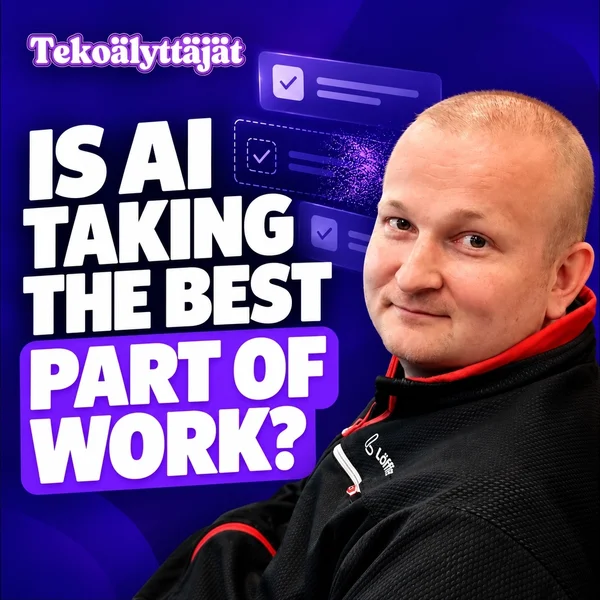
Mikko Heilimo on AI, Work, and Human Judgment
As AI takes on more of the execution, the work shifts toward setting direction, checking results, and taking responsibility.
What should people learn when AI can do more of the work they used to do themselves? DDScore Founder and CEO Mikko Heilimo joins Lotta and Silja on the Finnish Tekoälyttäjät podcast to discuss how AI agents could change work, what companies should prepare for, and how to start learning without chasing every new tool.
The episode is in Finnish. Watch the full conversation on YouTube.
From Doing the Task to Directing the Work
Heilimo sees a growing role for AI agents that carry out tasks across a workflow. In his view, more knowledge workers will spend their time defining the task, directing the system, and checking what comes back. Responsibility for the result remains with the person using it.
That shift is also personal. He describes how letting AI handle coding can remove part of the satisfaction he once found in solving a difficult technical problem himself. Adapting to AI means considering what makes the work meaningful, as well as what makes it faster.
Build a Learning Plan Around Your Actual Work
His practical advice is to plan learning at three horizons: what you want to understand in two years, what to learn over six months, and what to try this month. Then practice on real tasks alongside the work you already need to deliver.
The aim is to build useful capability through small, repeated steps. Watching demonstrations can give you ideas, but testing them in your own work shows where the benefits and limitations are. You do not need to follow every model release to make progress.
Ask What the Business Can Do With the Time It Saves
The hosts challenge a narrow focus on reducing headcount. The discussion also considers how a company could use the same capacity to serve more customers, improve its service, or take on work that previously cost too much to deliver.
Heilimo gives a concrete example from his own work: using AI to research an event, draft meeting requests, and help coordinate his schedule. He reviews the messages before sending them. The example shows how several connected tasks can become one assisted workflow, with human review still part of the process.
Keep Control of the Process
Moving a recurring workflow into AI raises questions about reliability, data access, and dependence on a particular provider. Heilimo warns that a model or tool update can change how a process behaves. Organizations need to understand and control the steps that affect their customers.
This connects with the DDScore example he introduces early in the episode: analyzing company materials to identify strengths, weaknesses, and areas for development. Producing an output is one step; understanding what supports it and deciding what to do next still require judgment.
Domain Knowledge Still Gives the Work Direction
Later, the conversation turns to creativity, entrepreneurship, robotics, and the future of professional work. Heilimo encourages people to understand a field as a whole: its customers, constraints, and how its different parts fit together. That understanding helps them choose useful tasks and evaluate the results.
The episode includes ambitious forecasts. Their timing is uncertain, and Heilimo acknowledges the difficulty of predicting the longer-term effects on society. His immediate advice is more concrete: choose something useful, start practicing, and build from there.
Explore an Analysis Report
See how DDScore organizes a company’s strengths, gaps, and risks, from the key findings to the detailed analysis.