

Claude is best used in strategy work as a thinking and drafting partner rather than a fixed measurement system. That is our reading of the practitioner accounts in the sources below, not a measured performance result: Claude AI business analysis works well when you give it your own materials, ask for structured comparisons and critical feedback, and check every claim against sources you trust. It is a weaker fit when you need the same answer to be reproducible months later, because a different model or a different prompt can produce a different draft of the same analysis. That is where a fixed structured assessment such as a DDScore report earns its place: the same twelve dimensions and the same 0 to 100 scale every time, so you can compare one company against another or the same company over time. This article covers what practitioners report Claude does well for strategy, concrete prompts you can run today, where answers may change between model versions, a worked example, and how to combine both tools without confusing a conversation with a measurement.
What Claude Does Well in Strategy Work
Our editorial recommendation, built on the practitioner accounts below, is to use Claude for three strategy tasks in particular: structuring market analysis, exploring scenarios, and mapping competitors. In each case, the value comes from how you frame the task. In the r/ClaudeAI discussion "Is Claude good for actual strategy/planning?" one commenter judges Claude excellent for strategy and planning when the prompts are right, and adds two conditions: do not try to one-shot the task, and do not ask for tentative dates or time estimates. That is one practitioner's judgment, not a measured result, but it is a useful starting posture for a leader. Treat the first answer as a draft to be worked on, not as a finished position.
Mohd Rizuan's LinkedIn post on customizing Claude for strategic decision-making draws the same line a different way. He writes that when he is making decisions, including campaign strategy and project direction, he needs Claude to be more than a "yes man." For strategy work, that means asking for critical feedback and counterarguments instead of agreement. This is one practitioner's stated working style, not a measured result. Our reading is that the style should match the task: challenge for a decision, plain execution for a routine job.
Anthropic's own material treats model choice as part of the job. The Anthropic page "Introducing Claude for Small Business" describes connecting the tools you already use and picking the job. The Anthropic Claude Academy collection "Claude for work" lists choosing among Haiku, Sonnet, Opus, and Fable as a practical decision that also keeps you inside your rate limit. Neither excerpt describes an approval workflow, so treat what comes back as material you review before it goes anywhere.
The cautions are concrete. In the r/BusinessIntelligence thread "what does chatgpt/claude do in analytics work that genuinely pisses you off?" one complaint is that it "confidently summarizes data that doesn't exist." In the r/ClaudeAI strategy thread, another commenter notes that the model already knows from the context what you would like to hear, so results can be shaped by that, and a third states that it is only as good as the data it has access to. In the r/ClaudeAI thread "How are you using Claude to run complex product strategy end-to-end?" a commenter describes his biggest unlock as ditching the "paste everything into context" approach. Together these argue for supplying curated documents, asking for citations, and verifying claims, rather than asking Claude to invent a market view from nothing.
Concrete Prompts for Market Analysis, Scenarios, and Competitors
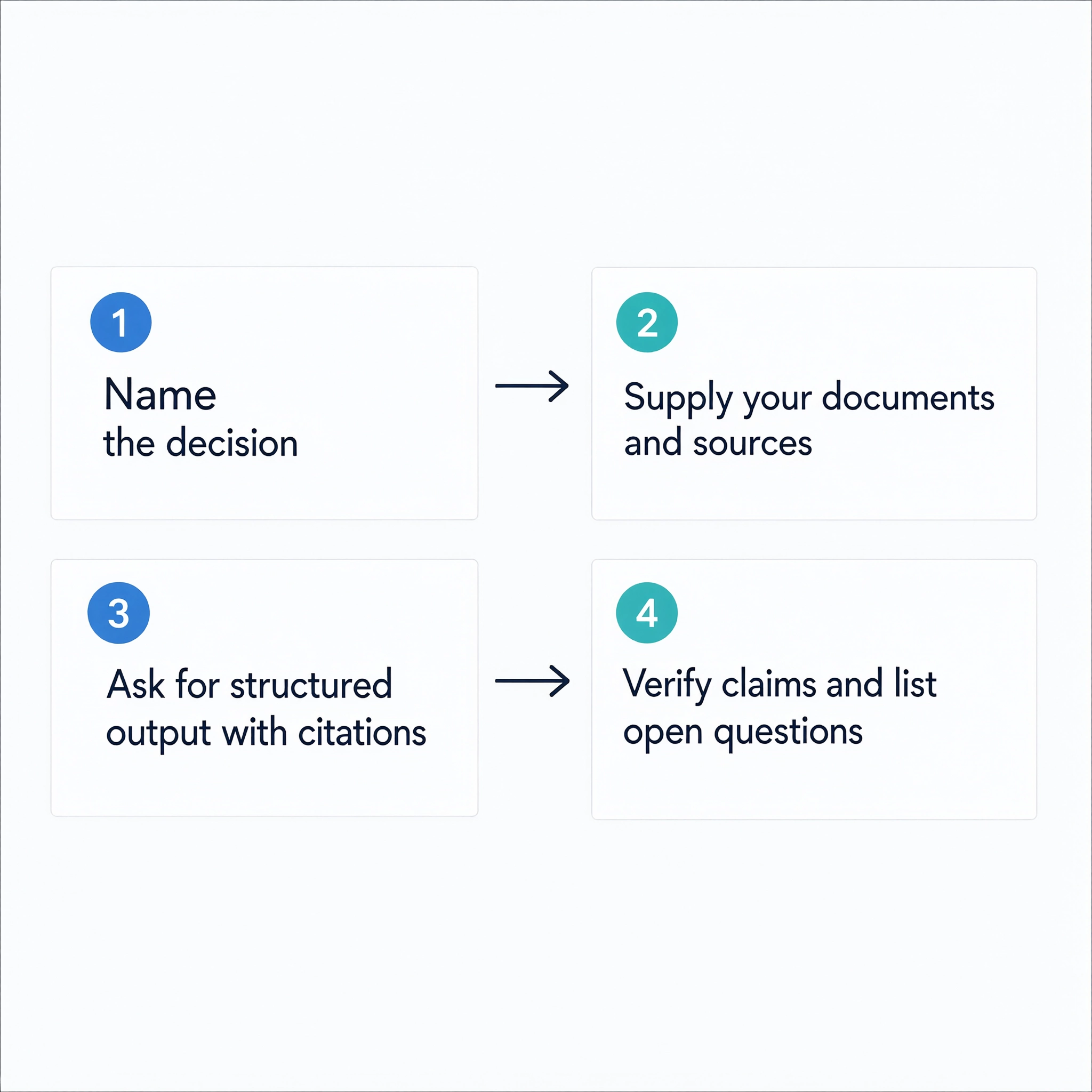
Good strategy prompts share four properties: they name the decision, supply the evidence, fix the output format, and ask for the reasoning to be visible. Below are prompts written for a leader preparing a strategy review. Replace the bracketed material with your own documents.
Market analysis prompt: "Here is our market note, our last two quarters of pipeline data, and three published industry sources. Build a market map for [segment]: demand drivers, segments we can realistically reach, and segments we cannot. For each claim, cite which of my documents or sources supports it, and list anything you could not verify as an open question. Do not estimate figures I did not provide."
Scenario thinking prompt: "Assume our base plan is wrong in one of three ways: demand arrives more slowly, price falls, or delivery costs rise. For each, describe the sequence of consequences for hiring, runway, and product focus over 18 months. State the assumptions behind each scenario and mark which assumptions I can test cheaply this quarter."
Competitor research prompt: "Here is our positioning document and a list of the alternatives our customers currently use. Identify where our differentiation claim is unsupported, where a competitor or substitute could neutralize it, and what evidence would settle the question. Separate what you know from the documents I gave you from what you are inferring."
Challenge prompt, for use before a board or investment discussion: "Argue against my proposed plan. State the two assumptions that would have to hold for this plan to work, then identify which of those assumptions the documents I gave you do not support. Do not agree with me unless the evidence in my documents supports it."
These prompts are built around the cautions in the sources above. The r/ClaudeAI strategy thread warns against one-shot prompting and against asking for tentative dates or time estimates, and notes that the output is only as good as the data it has access to. Mohd Rizuan's LinkedIn post is the basis for asking Claude to argue against the plan rather than agree with it.
Where Answers Change Between Model Versions
Answers may differ between model versions and between runs. The reason is straightforward: a different model, or a different prompt, can produce a different draft of the same analysis. The Anthropic Claude Academy collection "Claude for work" treats model selection as a real choice among Haiku, Sonnet, Opus, and Fable, which means the model you use today may not be the model you used last quarter. The supplied sources do not measure how much a strategy answer changes between versions, and model-choice information by itself does not demonstrate that answers change. What they do show is that model choice is a live variable, and that a practitioner in the r/BusinessIntelligence analytics thread has reported a model confidently summarizing data that does not exist.
Three practical consequences follow. They are our editorial recommendations, not findings from the sources. First, save the output itself, as a document or an exported transcript, and date it. Second, compare those saved outputs and your underlying data across time, rather than rerunning prompts and treating the new outputs as equivalent to the old. Third, source every number yourself, because a plausible figure with no citation looks exactly like a real one in the moment.
Saving an output and reproducing it are two different things. A saved transcript or exported document preserves the original wording, so saved Claude outputs can be compared over time in the same way as any other written analysis: put this quarter's strategy memo next to last quarter's and read what changed in the findings and the evidence behind them. What a rerun does not give you is that same record again. A new prompt run can return a differently worded draft, so a regenerated answer should never stand in for the original you already hold. Keeping the original as the comparison point, rather than regenerating it, is our editorial recommendation following the logic above, not a finding reported in the sources.
A Worked Example: Preparing a Strategy Review
Consider a hypothetical case, clearly labeled as such. A leadership team at a subscription software company is deciding whether to expand into a second country. The CEO has a draft plan and three weeks before a board discussion.
Step 1: assemble the inputs. The team collects the draft plan, the current pipeline by segment, pricing notes, the last board deck, and two public industry reports. Nothing confidential leaves the company's approved environment.
Step 2: run the Claude prompts above against those documents. The market prompt returns a segment map with citations to the team's own files and a list of unverified claims. The scenario prompt produces three 18-month paths. The challenge prompt names the two assumptions most likely to break the plan: that the first-country sales cycle repeats abroad, and that support costs stay flat with language coverage.
Step 3: verify. The team checks each cited figure against the source document it points to. One finding does not survive: the competitor prompt asserts that a named rival has exited one target segment, and no document in the pack supports it. The team discards the claim, logs it as an open question, and assigns an owner to find a source that can be opened. Another finding does survive: the reachable-segment list traces back to the team's own pipeline file and the two published industry reports, so it stays in the memo with those citations attached. The decision implication is immediate. The expansion case now rests only on the segments whose demand evidence traces to the team's own files and the two cited reports, and the case put to the board is conditional on closing the logged questions. This is the step that separates analysis from decoration.
Step 4: decide what to measure. The team agrees that the expansion question will be revisited with the same criteria: reachable demand, unit economics, delivery cost, and regulatory exposure. Those criteria need to be stable, because the board will ask what changed since the last review.
Step 5: run a fixed structured assessment on the company itself. A DDScore analysis takes the submitted materials, cross-checks them against each other and against current public information related to the claims in those materials, and returns an overall 0 to 100 score with a score and analysis-confidence figure for each of twelve dimensions: Business Idea, Offering, Team, Market, Competitors, Technology and IP, Scalability, Legal and Regulatory, Exit, Presentation, Financials, and Fundability. A report generally takes 10 to 30 minutes. A leader in this position can run the analysis on their own company, or on a company they are considering investing in, using the materials they already have. A pitch deck is enough to produce a useful initial read, and additional financial, compliance, and use-of-funds material can improve completeness.
Step 6: compare like with like. The team runs the same analysis again after the quarter with updated materials. Hypothetical continuation: the new pack adds signed customer contracts in the second-country segment and a corrected delivery-cost model. In the repeat report, the Market and Financials dimensions carry new supporting material, their confidence figures read differently from the baseline, and the open questions from the first run are either answered by documents or still listed as gaps. The team reads the dimension findings, evidence limitations, and confidence figures alongside the overall score, because the score alone does not say what changed. The decision implication: if the gaps that drove the earlier caution closed with new documents, the expansion case can go to the board with the remaining open questions named; if they did not, the same criteria apply and the plan waits. Because the dimensions and structure are fixed, the comparison is between evidence and gaps rather than between two differently phrased chat sessions. Compare the reasoning, not only the score, since current public information can also change between analyses.
Why a Fixed Structured Assessment Gives a Stable Basis
The core difference is between exploration and a standard. A Claude chat output is a draft produced for that conversation, which is a strength for thinking through options and a weakness for comparison, because rerunning the same prompt is not guaranteed to reproduce it. The practical contrast is this: an exploratory conversation may return a differently worded draft each time you run it, while a fixed assessment returns the same twelve dimensions and the same 0 to 100 scale, so the comparison rests on evidence and gaps rather than on phrasing. DDScore applies that same structure across cases, so different companies can be reviewed against one structure and the same company can be analyzed again later to see how its evidence and gaps changed. Consistent structure supports comparison. It does not guarantee identical processing or identical results, because the submitted materials and the current public information can differ between analyses.
The report separates strengths, areas for development, risks, evidence limitations, and analysis confidence by dimension, and it records questions tied to the evidence gaps that matter for further human review. That separation is what makes a repeat comparison useful: you can see where a finding rests on solid material and where it rests on thin material, instead of reading one number on its own.
The limits are equally important. DDScore is an analytical first-pass tool. It does not provide investment advice, does not choose investments, and does not replace full diligence. Missing evidence does not prevent analysis, but it can lower confidence and limit the depth of findings. A report used with a board or a funder is supporting analytical material, not an audit, a credit rating, or a guarantee of any financing outcome. Human decision-makers remain responsible for considering the context and making the final decision.
Used together, the two tools have distinct jobs. Claude helps you think, draft, and challenge. A fixed structured assessment gives you a repeatable record to compare over time. A leader who wants that record can run a DDScore analysis on their own company before the next review, or on a company they are considering investing in, and use the report as the baseline for a later repeat analysis. Neither tool makes the decision.
Checklist Before You Rely on a Strategy Output
Use this checklist on any Claude-generated strategy material before it reaches a board, an investor, or your leadership team.
1. Decision named. The output answers one specific question, not a general request for strategy.
2. Inputs supplied. Your own documents, figures, and sources were provided, and the output cites them.
3. Claims verified. Every number and every competitor claim was checked against a source you can open.
4. Gaps labeled. Unverified items are listed as open questions rather than smoothed into the narrative.
5. Assumptions exposed. The scenario or proposed plan states what must be true for it to hold.
6. Version recorded. You saved the document, noted the date and model used, and did not rely on rerunning the prompt to reproduce the earlier answer.
7. Stable criteria agreed. The next review will use the same dimensions and the same evidence standard, so the comparison is meaningful.
8. Human owner assigned. Someone is responsible for the decision and for commissioning specialist checks where the analysis flags legal, financial, or technical questions.
A leader who follows this sequence gets the speed of Claude for business strategy work and the comparability of a fixed assessment, without confusing one for the other.
Explore DDScore for Founders · Explore DDScore for Investors