

Can a CEO use ChatGPT to analyze their own company? The short answer is yes—as an initial drafting and questioning partner, not as the evidence base. ChatGPT company analysis works best when you supply the business context, ask for sources, and treat every output as a starting point you verify. The US Chamber of Commerce puts the mechanism plainly: ChatGPT "isn’t a mind reader—it draws only from the information it’s been trained on, as well as what you share." This article gives you a practical prompt set for strategy, market, competition and finances, shows where answers drift between runs or arrive without evidence, and explains how adding a structured DDScore report to a ChatGPT project gives the conversation a consistent, checkable basis to work from.
Can ChatGPT Analyze My Business?
Yes, within limits. ChatGPT can help structure a SWOT, list direct and indirect competitors, draft a competitor comparison, summarize a financial dataset you upload, and challenge the logic of your strategy. What it cannot do on its own is know your company. Silvon's analysis of generative AI in business data states the distinction directly: "Generative AI doesn’t inherently understand your business." It does not know how your finance team defines gross margin, which spreadsheet holds the authoritative revenue figure, or whether "customer" means the billing account or the ship-to location.
That gap determines how you should use it. The useful pattern for a CEO is to give the model your definitions and your numbers, ask for reasoning you can trace, then verify the claims that matter before they reach a board deck or an investor conversation. Coursera's guide to ChatGPT for competitor analysis recommends the same posture: "you should approach it as a starting point or a rough draft, not a complete report."
The practical consequence is that ChatGPT company analysis is a thinking tool with an evidence problem, not a research department. You get speed and structure. You still own verification.
What Prompts Should a CEO Use for Strategy, Market, Competition and Finances?
Start each session with a context block rather than a bare question. State your industry, business model, customer segment, stage, and the decision you are trying to make. Then use one prompt per question so you can compare answers across runs.
For competition, the US Chamber prompt is a workable template: "As a small business in [industry], help me identify my top competitors, both direct and indirect. Then, provide a detailed analysis in line with that of a market research consultant to highlight key differentiators I could emphasize in my own marketing and branding." Follow it with a verification prompt: list which claims came from your own materials, which came from public sources, and which are inferred.
For strategy and capital allocation, OpenAI's executive prompt library offers a trade-off frame: "We’re choosing between [Option A] and [Option B] for our next big investment. Compare trade-offs across cost, time, team capacity, and customer impact. Recommend based on goal fit." Ask for the assumptions underneath the recommendation, then mark each one true, unknown, or contested.
For market and investor context, you need current information rather than whatever the training data holds. OpenAI's own guidance for executive use says to "Use deep research for deeper real-time insights," which matters because a plain chat answer may rest on stale training data. Here is a prompt you can adapt for the task, written by us rather than quoted from OpenAI: "Research the latest funding and market trends in [industry]. Focus on valuation benchmarks, risk sentiment, and notable exits. Present the findings in a concise brief with sources." Treat it as a starting point and check every source it returns.
For finances, upload a sanitized dataset and ask three separate questions: what changed, what caused it, and what would falsify your reading. Keep the arithmetic visible. Ask the model to show the calculation so your CFO can check it line by line.
A compact prompt set that covers the four areas: (1) SWOT with external and internal factors in your industry, (2) direct and indirect competitor list with differentiators, (3) option A versus option B trade-offs across cost, time, team capacity and customer impact, (4) revenue and churn trends from an uploaded file with stated assumptions. Run them in the same project so the context carries across.
How Do You Give ChatGPT the Context It Needs?
Context is the difference between a generic answer and one that sounds like it came from someone who knows your company. Provide a short company primer at the start of the project: what you sell, to whom, at what price, through which channel, with your current stage and the two or three numbers you run the business on.
Be selective about what you upload. The US Chamber guidance is explicit: "Be aware: As a best practice, avoid uploading sensitive business data or personally identifiable information (PII) to AI platforms." Use rounded or redacted figures when the precision is not needed for the question you are asking.
Define your terms in the primer. Silvon's data analysis piece explains why definitions matter: "That’s one reason identical questions asked against different datasets can produce different answers." Silvon is describing different datasets; the same problem appears in wording. If your gross margin excludes implementation labor and the model assumes it includes it, every downstream conclusion inherits the error. That gross-margin case is our illustration of the risk, not a finding Silvon tested.
Finally, tell the model what a good answer looks like: the format, the length, whether sources are required, and what it should flag as unknown. Specificity is what turns a plausible paragraph into something you can act on.
Where Does ChatGPT Company Analysis Drift or Lack Evidence?
Three failure modes matter for a CEO. The first is hallucination. Coursera's guide defines it plainly: "AI tools, including ChatGPT, sometimes provide you with data that looks legitimate but is inaccurate. This is a phenomenon known as a hallucination." The danger in a company analysis is not an obviously wrong sentence. It is a confident market size, a competitor's revenue figure, or a customer count that no source supports and that you repeat in a board meeting.
The second is variation between runs, which needs careful wording. The sources here do not measure how much two otherwise identical prompts differ, so there is no percentage to give you. What Silvon does establish is input-driven difference: "That’s one reason identical questions asked against different datasets can produce different answers," and its broader point is that "AI accelerates reasoning. It does not automatically improve data quality." Change your primer, your figures or your definitions and the answer changes with them. Asking the same question twice against the same context is a separate question, and the practical test is yours to run: repeat the same prompt in the same project, save both outputs, and compare them claim by claim. When two runs differ, neither is automatically the right one, and anything that would change a decision still needs a source.
The third is staleness. Coursera notes that "in some cases, the recency or information cutoff dates of the data ChatGPT trains on may affect its insights, potentially leading to lower-level, outdated results." A competitor that launched, raised, or pivoted after the cutoff may be described as it was, not as it is.
An informal Reddit post about a deep-research prompt illustrates incompleteness and the poster's own uncertainty rather than measuring anything: one user reported that "ChatGPT 5 with think deep / deep research generated a 6 page report that covered most but not all 25 points requests and it was much more concise," and added, "My confidence level would be less of it not making up answers." That is one person's anecdotal account of a single report that missed some requested points, with the author stating lower confidence in its accuracy. It is not a benchmark, not a comparison of tools, and not a measurement of how outputs change between repeated runs. Treat it as a reason to verify, not as a ranking.
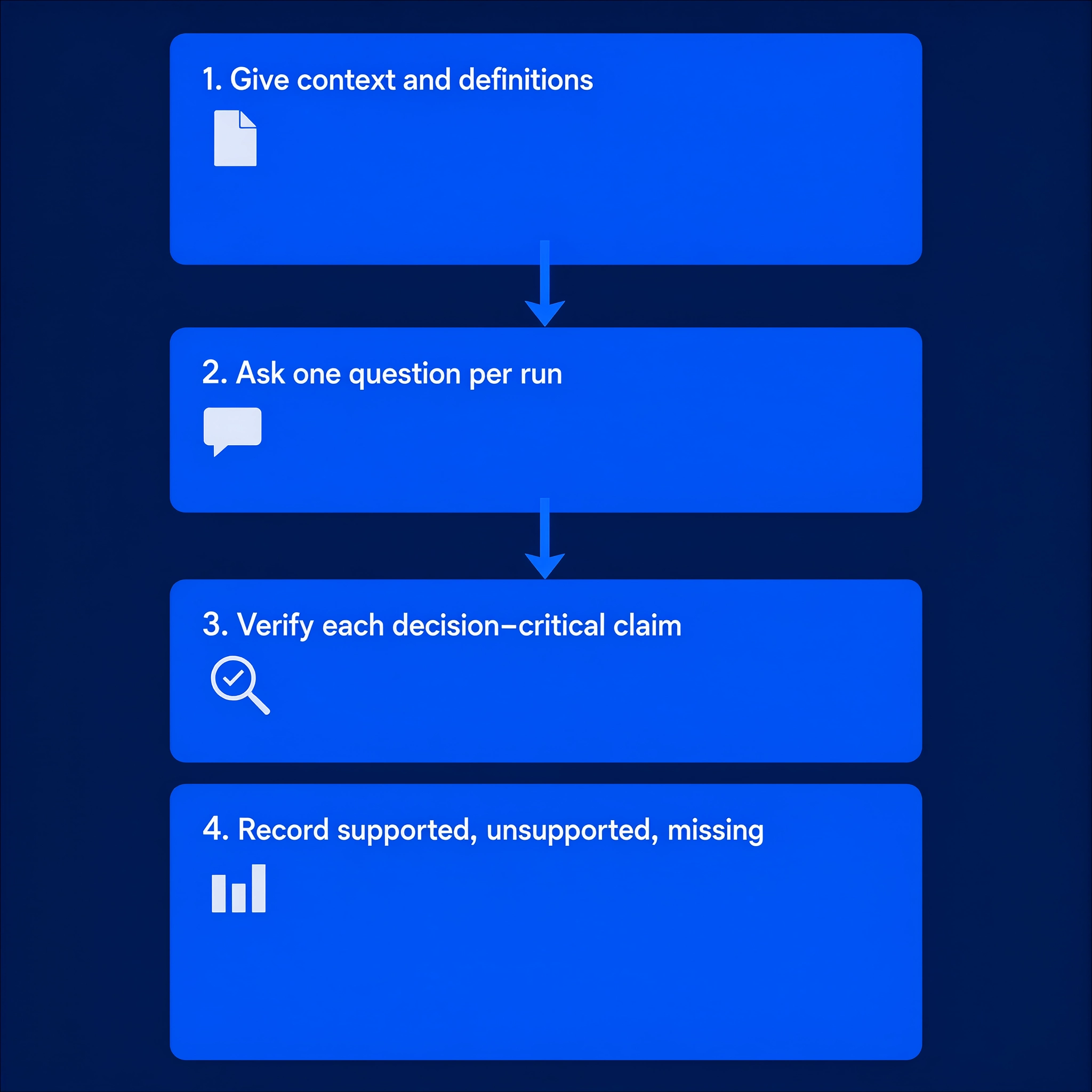
The practical response is a verification loop: for every claim that would change a decision, ask for the source, check it yourself, and record whether it was supported, unsupported, or simply missing. Missing evidence and adverse evidence are different findings. Adverse evidence may point to a risk or a possible problem worth investigating; it does not by itself prove that something is wrong with your business.
What ChatGPT Does Well for a CEO
ChatGPT is strong at structure and speed. The published guidance behind the prompts above treats it as a first-pass drafting tool: the US Chamber's competitor prompt asks the model to work "in line with that of a market research consultant," and Coursera's guide tells readers to treat the result as "a starting point or a rough draft, not a complete report." Used that way, it can produce a first-pass SWOT, organize competitor findings into a comparison, and draft the agenda and the follow-up questions for your next review. It is also useful for pressure-testing your own reasoning: ask it to argue against your strategy, list the assumptions that would break it, and name the questions an investor would ask.
You can also ask it to recast the same material for different audiences: a board pre-read, a leadership off-site prompt, or a short internal memo, with the level of detail adjusted each time. Check every rewrite against the original before it leaves your desk.
Where it stops is exactly where evidence begins. Do not assume a chat output has been independently checked; treat it as unverified until you or someone on your team has checked it. Contracts, accounts, technology, and a competitor's current pricing still need human or specialist verification, and that responsibility stays with you. The value of the tool is that it gets you to the right questions faster, so your limited review time lands on the questions that decide the outcome.
How Does a DDScore Report Give a ChatGPT Project a Consistent Basis?
A DDScore report gives the conversation a fixed reference point. DDScore turns private-company materials such as a pitch deck, financial notes and use-of-funds material into a structured 0–100 score plus a written report. It analyzes the company across twelve fixed dimensions: Business Idea, Offering, Team, Market, Competitors, Technology & IP, Scalability, Legal & Regulatory, Exit, Presentation, Financials and Fundability. Each dimension carries its own score and analysis-confidence figure, with strengths, areas for development, risks and evidence limitations set out in writing.
What the report fixes is your side of the conversation, not the model's. A DDScore report is a dated, written artifact built on the same twelve dimensions and the same structured probability model each time, so the document your prompts refer to does not change between Monday and next quarter. The assistant itself can still answer differently from one session to the next. What changes is that every answer can be checked against one fixed reference: when a response claims the report says something, you can open the report and see whether it does.
The workflow is simple. Run a DDScore analysis on your own company, save the report, and add the PDF to a ChatGPT project alongside your company primer. Then ask questions about it: Which findings rest on evidence in my materials, which on public sources, and which on inference? What would an investor push on first? Which three gaps should we close before the next board meeting? The report's follow-up questions, tied to its evidence gaps and risks, give you a ready-made starting list. Check each answer against the report itself: any claim the response attributes to the DDScore report must cite a passage you can open in the PDF, or the attribution fails. Other claims in the same answer still have to identify their actual evidence, whether that is your company primer or a public source you can check.
The same approach works for an investor analyzing a company they are considering. Upload the report and ask what the score rests on, where confidence is thin, and which questions to put to the founder.
Keep the boundary clear. A DDScore report is analytical input for your judgment. It does not provide investment advice, choose investments, or replace a full due diligence process, and it does not make your board or investment decision for you. Its value here is narrower and real: a consistent, evidence-linked document that your ChatGPT work can stand on instead of a fresh set of unverifiable claims each session.
A Worked Example: One Company, Two Passes
The following is a hypothetical example, invented to show the method. No real company, real report or tested run stands behind it.
Situation: a hypothetical seed-stage software company selling annual subscriptions to mid-sized logistics operators, with roughly 40 customers, a founder-led sales motion, and a plan to hire two account executives before the next board meeting. The CEO wants an outside read on strategy, market, competition and finances.
Pass one, ChatGPT only. Give the model a redacted primer: industry, product, customer segment, stage, headline revenue and churn figures, and the hiring plan. Ask for a SWOT, a direct and indirect competitor list, and the three assumptions most likely to be challenged. Mark each claim S (supported by your materials), U (unsupported), or M (missing). In this hypothetical output, the SWOT's internal items trace back to the primer and are marked S; three competitor names arrive with no source and are marked U; a market-growth figure appears that you never supplied and is marked U; and a churn comparison is marked M because no benchmark was provided. Those U and M items are the ones to source or discard before anything reaches a board deck.
Pass two, DDScore report in the project. Run the analysis on your deck and financial notes, save the PDF, and add it to the same project. Ask the same questions again, but require each answer to cite the dimension and the written finding it comes from, then open the PDF and check that the cited passage is really there. In this hypothetical second pass, the Market dimension carries a written finding that the reachable-customer estimate in the plan is not evidenced in the materials, and the Financials dimension notes that the two planned hires are not reflected in the runway figure shown, each with its own analysis-confidence figure. The CEO's next action changes: instead of debating a market-growth number she cannot source, she takes two specific items to the board—a customer-segment breakdown to supply and a decision on whether the hiring plan waits for it—and she confirms that each report finding she quotes actually appears in the document.
Two cautions. Agreement between the two passes is not independent confirmation; both can rest on the same unverified input. And a traceable citation is only as good as the finding behind it, so read the report's own confidence and evidence limitations before you repeat a finding.
The output you take to the board is not the score. It is a short list: the findings both passes agree on, the claims only ChatGPT made that you could not source, and the gaps the report marks as material. That is a document a board can challenge item by item rather than debate as a whole.
Explore DDScore for Founders · Explore DDScore for Investors