
SpaceX IPO DDScore Report
Read the full DDScore report on Space Exploration Technologies Corp. (SpaceX), the reported June 2026 Nasdaq IPO case, ticker SPCX, and the valuation risk around a $1.75T-$2.0T pricing range.
SpaceX, SPCX and the $2T IPO Case
This DDScore report reviews Space Exploration Technologies Corp. (SpaceX) as a reported June 2026 Nasdaq IPO candidate under the expected ticker SPCX. The report covers the company's launch business, Starlink scale, Starship execution path, regulatory exposure, financial profile and the reported $1.75T-$2.0T valuation range.
The full report above is the primary asset. The sections below make the report readable in HTML for search engines and for readers who want the main map before opening the full PDF.
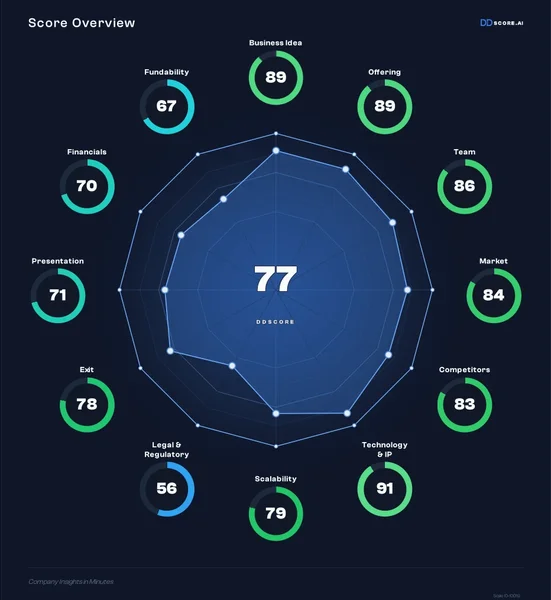
Score Breakdown
The report places SpaceX in a favourable read profile, with exceptional technology, offering and market scores offset by regulatory, governance, financial and valuation tension.
What the Report Highlights
- Valuation sensitivity: at a reported $1.75T-$2.0T IPO valuation, the report argues that a large amount of future success is already priced into the case.
- Starship execution: even with multiple business lines, Starship remains the largest return variable because cadence, reliability, cost and regulatory clearance drive much of the upside case.
- Starlink ARPU compression: the report flags declining Starlink average revenue per user as one of the most important unit-economics signals for the broadband story.
- Financial tension: the report references approximately $14.1B of 2025 revenue alongside roughly $14B of capex, about $9B of R&D and widening net losses.
- Regulatory and litigation exposure: FAA, FCC, ITU, ITAR/EAR, DOJ and NLRB issues are material to the risk map, alongside worker-safety, licensing and policy scrutiny.
- Technology moat: Falcon 9 reusability, Raptor/Starship development, Starlink vertical integration, launch infrastructure and spectrum rights support unusually strong Technology & IP and Offering scores.
- Governance and key-person risk: the report highlights Gwynne Shotwell as an operational strength while noting Elon Musk concentration, divided attention, board independence and related-party transaction risks.
How to Read This DDScore IPO Report
The report is built around DDScore's private company due diligence framework: business idea, offering, team, market, competitors, technology and IP, scalability, legal and regulatory, exit, presentation, financials and fundability. The score is not a price target or investment recommendation. It is a structured view of the materials, public-source context, benchmark patterns and the DDScore scoring model.
For SpaceX, the strongest areas are technology and IP, business idea, offering, team, market and competitors. The lower-scoring areas are legal and regulatory, fundability, financials and presentation. That combination is why the report reads as a high-quality company with a demanding valuation: the business is unusually strong, but the IPO entry price leaves less room for execution, regulatory or unit-economics disappointment.
Readers reviewing the SPCX IPO case should focus especially on Starship commercial cadence, Starlink ARPU stabilization, segment-level financial disclosure, related-party transactions, regulatory status, capital intensity, governance controls and whether the implied valuation leaves enough expected return after those risks.
DDScore does not provide investment advice and does not tell users what decision to make. DDScore provides analytical tooling and quantitative scoring based on submitted materials, available information, benchmarks and the DDScore scoring model. It supports judgement and due diligence workflows. It does not replace investor judgement or a full due diligence process. Investing in private companies involves significant risk, including the possible loss of all invested capital.