
Anthropic IPO: A Huge Opportunity, but Who Captures the Value of AI?
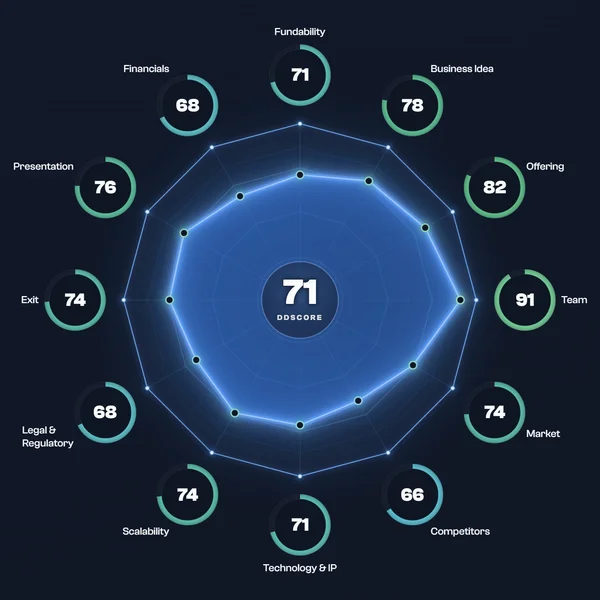
DDScore gives Anthropic 71/100. Its growth and technology are strong, but can it turn the AI transformation into sustainable earnings that justify the IPO price?
Updated November 18, 2026 using the latest DDScore report.
Anthropic’s proposed IPO presents an enormous opportunity and a demanding valuation question. The US$74 share price used in DDScore’s November 18 report implies approximately US$968 billion in post-offering equity value. The proposed price range is US$70–US$78. This is not yet a final IPO price.

Strong Evidence, Uneven Investment Risk
The report's strongest dimensions are Team (91), Offering (82), and Business Idea (78). Competitors scores 66; Financials and Legal & Regulatory each score 68. Exit scores 74.
The overall score describes the assessed business case. It is not a 71% probability of making money.
The Transformation of Knowledge Work Could Be Enormous
In one US-focused scenario from the Anthropic Institute, AI could perform half of the knowledge-work tasks of 2026 by 2030. Technical capability does not mean adoption will move at the same pace: in that scenario, most knowledge-work tasks are still performed without AI. Read the Anthropic Institute research.
For investors, the question is not simply how much work AI can do. What matters is how much additional economic value it creates and who captures it.
In our separate valuation assessment covering 2026–2030, we use approximately 3% as a reference point: under the calculation’s assumptions, roughly that share of the additional value created by AI would need to accrue to Anthropic to justify the IPO valuation being assessed.
A Provider of AI Work or an Easily Replaced Model Service?
Anthropic’s major opportunity is to become one of the central companies through which AI performs work worldwide. If its models and services create substantial customer value and the company retains enough of that value, even today’s valuation could eventually look inexpensive.
Another possible path is much harder for investors. Differences between models could narrow, prices could fall, and customers could switch providers more easily. Much of the benefit could then go to customers or to companies building complete workflows and applications on top of the models.
Providing models and tokens alone does not make a business unattractive. A provider can succeed if quality, cost efficiency, and reliability create a lasting competitive advantage. The risk is becoming easily replaceable and losing pricing power. Successful competitors, including Chinese model developers, could increase that pressure.
What Do the Return Scenarios Show?
The report’s return summary shows a probability-weighted return multiple of 1.3× over five years. The modeled outcomes assign 50% probability to making money and 50% to losing money. The middle half of outcomes falls between approximately 0.3× and 1.9× the initial investment.

The scenarios show how the same company can produce very different outcomes for an investor. A strong business alone does not make a stock purchased at a high price a good investment.
These figures are model outputs, not promises. The report’s detailed Exit narrative also calculates approximately 1.02× from five separate illustrative point outcomes. That is a different calculation from the summary’s 1.3×, and the figures should not be used interchangeably. Read the return summary and Exit assessment.
A Large Cash Balance Does Not Eliminate Financing Risk
According to the report, Anthropic had approximately US$131.8 billion in cash and short-term investments at the end of September. Estimated combined net proceeds from the IPO and concurrent private placement would be approximately US$84.6 billion if both transactions close.
Against that stand approximately US$900.9 billion in purchase and lease commitments across different periods. About US$70.7 billion falls due within the next twelve months. Not all commitments are unconditional, and the full amount does not fall due at once. Their scale nevertheless makes growth, pricing, and cash flow critical.
The risk is that current financing and future cash flows may not be sufficient to execute the plan. The report does not establish a date when cash would run out. It does identify the possibility that the company will need to return to capital markets repeatedly.
Conditional partner arrangements already provide for potential additional financing. That is not the same as a confirmed next public share offering. New shares and convertible-note conversions could nevertheless dilute the ownership of investors entering at the IPO. Read the financing and ownership assessment.
New Investors Enter on Different Terms
An IPO investor does not receive the same starting position as every earlier financier. The report highlights Amazon’s convertible-note conversion prices of US$2.09 and US$5.05 compared with the assumed US$74 IPO price. Ownership caps and other conditions apply, so the full potential dilution should not be treated as occurring at the offering.
Control also differs. The founders’ special voting power and the Long-Term Benefit Trust’s board rights limit the influence of ordinary public shareholders.
Investors therefore need to assess not only company growth but also how much of its future value will ultimately belong to each share they own. Growth in the company’s value and the return on an individual share are not the same thing. Read the DDScore report.
Who Remembers Netscape?
Netscape, AltaVista, and Sun Microsystems remind us that a well-known pioneer of a technological transformation does not necessarily remain an independent winner. Their stories differ, and an acquisition does not itself mean investors lost money. The shared lesson is that today’s recognition does not guarantee tomorrow’s competitive advantage. Netscape, AltaVista, Sun Microsystems.
The same question applies to Anthropic over the next 5–10 years. If it becomes a lasting central provider of AI work, the opportunity is enormous. If its competitive advantage and profitability erode while substantial commitments and financing needs continue, an investor could lose most of the investment.
AI’s success alone does not guarantee the success of Anthropic’s stock. The investment case depends on how much of the transformation’s value remains with the company and ultimately its shareholders.